
Multi-axis machining is any CNC process where the cutting tool or the workpiece moves along more than the three basic linear axes. Most shops know the three: X moves left and right, Y moves front and back, and Z moves up and down. A 3-axis machine cuts on those three planes. Add a rotary axis that turns the part, and you have 4-axis machining. Add a second rotary axis, and you have 5-axis machining. The term "multi-axis" means the machine controls more than three axes at once to reach surfaces a basic mill cannot.
What Each Axis Does
A linear axis moves the tool or the table in a straight line. A rotary axis spins the part around one of those lines. On a typical 5-axis machining center, two rotary axes let the spindle approach the workpiece from almost any angle without the operator stopping to re-clamp.
The practical effect is easier to see than the math. A 3-axis mill can only cut the top face and the four sides of a block in a single hold. To reach an angled hole on the bottom, or a curved surface on a side, the operator must unclamp, rotate the part by hand, re-fixture, and re-zero. Every one of those steps adds time and a chance for error. A 4-axis or 5-axis center reaches those same features by tilting the part under the spinning tool, so the cut happens in one continuous program.
DELICNC's breaks down each axis and the order in which they engage, which helps when you are matching a center to a part list.
3-Axis, 4-Axis, and 5-Axis Compared
The choice between these configurations comes down to geometry, not prestige. Each step adds cost and programming complexity, and each step removes a manual operation.
3-axis. Best for flat plates, simple pockets, and parts whose features all sit on the top face or the four orthogonal sides. This is the workhorse for brackets, adapter plates, and many aluminum structural parts, and DELICNC builds 3-axis centers for exactly this work.
4-axis. Adds a rotary table, usually around the X or Y axis. It suits parts with features around a round body: manifolds, hubs, collars, and any component where holes or slots repeat around a circumference. The rotary axis indexes or rotates continuously while the tool cuts.
5-axis. Adds a second rotary axis so the spindle head or the table can tilt. This reaches compound angles, sculpted surfaces, and features on multiple faces of a casting or forging. DELICNC fits 5-axis heads to its gantry and VMC lines for exactly these shapes.
DELICNC's lays out the trade-offs in table form, including the part sizes each one handles well.
When Multi-Axis Machining Pays Off
A multi-axis center is not automatically better. It earns its place when the part or the production plan shows one of these signs.
Features on multiple faces. If a part needs accurate holes or profiles on three or more faces, 3-axis work means re-fixturing between faces. Each re-clamp risks a shift in position. A DELICNC 4-axis or 5-axis center holds the part once and cuts every face in the same program.
Compound or angled surfaces. Any surface that is not flat and not aligned to the three primary planes is slow and inaccurate on a 3-axis mill, because the tool must step across it in tiny flat layers. A DELICNC center with a tilting spindle follows the curve directly, leaving a cleaner surface and a shorter cycle.
Tight positional tolerance between faces. When a hole on the bottom must line up with a pocket on the side within a fraction of a millimeter, the only reliable way is to machine both in one setup. Multi-axis machining keeps that relationship locked because the part never moves.
High mix or short runs. Shops that change parts weekly lose the most time to manual handling. Fewer setups means a new program starts cutting sooner, which matters more than raw spindle speed for low-volume work.
Large or awkward parts. Long aluminum profiles and wide panels are hard to flip by hand. A DELICNC gantry or profile center with rotary axes holds the whole length and reaches features along it without manual rotation.
When 3-Axis Is Still the Right Call
Spending on extra axes you do not need hurts the budget without helping the part. Keep a 3-axis center, the kind DELICNC builds for volume work, in the plan when:
Every feature sits on the top face or the four sides of a simple block.
Tolerances are open enough that a re-clamp shift stays within spec.
Volume is high and the part is identical run after run, so fixturing is fixed and rarely changes.
The material is easy to handle and the part is small enough to flip quickly.
A common mistake is buying 5-axis capability to make 3-axis parts. The machine sits underused while the shop pays for a control system and rotary hardware it never engages. Match the axis count to the hardest part you run, not the part you hope to win someday.
The Machine Behind the Method
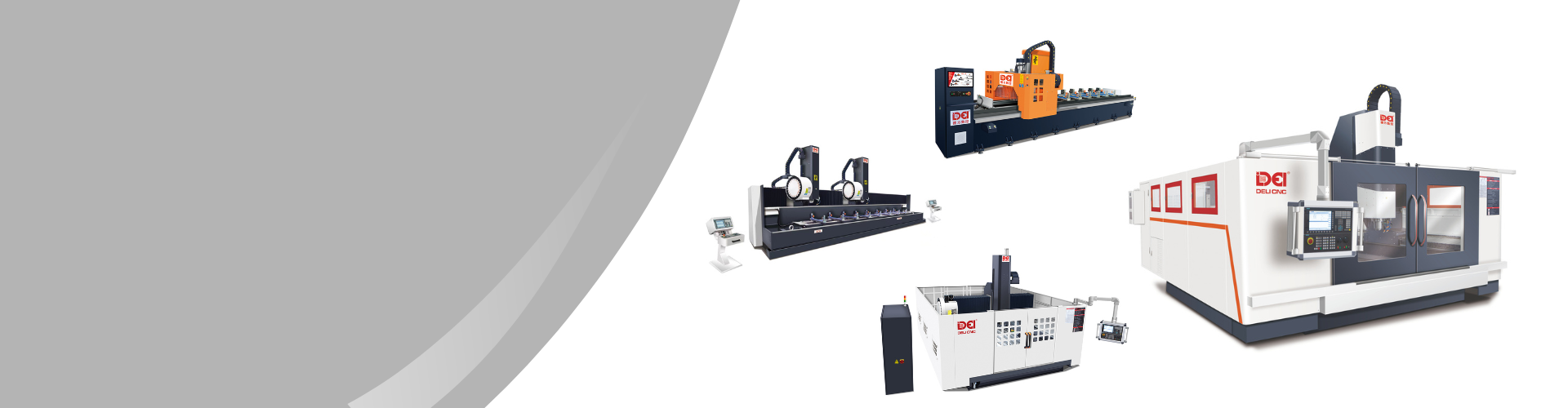
Multi-axis machining is a capability of the center, not a separate process. The same program logic applies on different frames, and DELICNC builds several that carry 4-axis and 5-axis options:
Vertical machining centers for mid-size parts where the work fits under a fixed bridge and the table moves in X and Y.
Gantry machining centers for long or wide parts where a moving bridge spans the workpiece and gives the rigidity large aluminum sections need.
Profile machining centers for aluminum extrusions and curtain wall sections where length and repeat cutting down the bar matter more than a small footprint.
The shows the frame sizes and axis options DELICNC offers for large-part work, which is where multi-axis control tends to deliver the biggest setup savings. For a concrete 5-axis gantry built for this, DELICNC's pairs tilt axes with a rigid bridge for wide panels and long profiles.
Long Aluminum Profiles for Curtain Wall and Rail
The case for multi-axis control is easiest to see on long aluminum extrusions, the kind DELICNC cuts for curtain wall mullions and rail transit sections. A mullion can run several meters with holes on the end faces, slots along the sides, and compound-angle cuts where it meets the next section. A 3-axis plan treats each orientation as a separate job: the operator clamps one end, machines the end face, unclamps, flips the bar, re-fixtures, and repeats down the length. Every flip is a chance to lose the relationship between the first hole and the last.
A 4-axis or 5-axis profile machining center holds the bar along its length and rotates it under the spindle to reach every face in one program. DELICNC builds for exactly this work, with the rotary axis and long T-slot bed matched to typical extrusion lengths. The part never leaves the datum, so a hole at one end lines up with a feature at the other within tolerance, and the operator loads stock once instead of handling the bar between every operation.
Multi-axis is not "better" in the abstract. For a part this long, the manual flips eat the schedule and break the accuracy, and multi-axis machining removes them.
How Extra Axes Cut Setup Time
Setup time is where a DELICNC multi-axis center recovers its cost, often more than through faster cutting. Consider a part that needs work on five faces:
On a 3-axis center, that is four re-fixtures, four re-zeros, and four chances to introduce error.
On a 5-axis center, it is one hold and one program.
The cycle per part may look similar on the clock, but the labor between parts disappears. An operator loads the raw stock, starts the program, and walks away until the part is finished. For a shop running dozens of different parts a week, that reclaimed handling time is the real gain, not the spindle speed.
Fewer setups also mean fewer fixtures. A 3-axis cell needs a custom jig for each face orientation. A DELICNC multi-axis center uses one vice or one dedicated fixture and reaches the rest with rotation. Lower fixture cost and faster changeover together shorten the return on the machine.
Cost and Return Considerations
A multi-axis center costs more up front, and the programming needs more skill. The return comes from three places:
Less scrap. One setup removes the cumulative error of repeated re-clamping, so more parts pass first inspection.
Less labor per part. Operators spend time loading and unloading, not re-fixturing and re-zeroing.
More parts per day. Shorter changeover lets a given shift output more distinct jobs.
The break-even depends on mix. A shop cutting one giant run of a simple part may never see the payback. A shop with a wide variety of complex parts usually sees it within the first year, and DELICNC customers report the savings compound across every job that no longer needs manual rotation.
Common Mistakes When Moving to Multi-Axis
Buying the axis count before the part. Specify the machine to the hardest real part on the list. If that part is 4-axis work, a 5-axis center is insurance, not a requirement.
Ignoring rigidity. Extra axes only help if the frame stays stiff while it tilts. A light machine that flexes under the cut loses the very accuracy the rotation was meant to protect. DELICNC sizes gantry and profile centers for the deflection the part will see, because a tilting spindle on a soft frame adds angles but not precision.
Underestimating programming. Multi-axis toolpaths need a programmer who understands collision avoidance and rotary limits. DELICNC supplies proven post-processors with its multi-axis centers, which removes most of this risk.
Forgetting the fixtures. A multi-axis center still needs a holding method that clears the tilt range. Plan the fixture before the machine arrives, not after.
FAQs
Is 5-axis the same as 3+2 axis?
Not exactly. In 3+2 mode the rotary axes hold a fixed tilt while the three linear axes cut, which reaches angled faces without full simultaneous motion. True 5-axis moves all five axes together for curved surfaces. Many DELICNC centers run both modes, and 3+2 covers most angled-feature work at lower cost.
Do I need 5-axis for aluminum?
Only when the part has compound angles or features on several faces. Flat aluminum plates cut fine on 3-axis centers. The material is easy to machine; the geometry is what drives the axis choice.
Can a 3-axis center be upgraded later?
Sometimes, with a rotary table added to the existing control. DELICNC offers rotary tables that add 4-axis capability to a 3-axis center, though the result will not match the rigidity or envelope of a center built as multi-axis from the start.
How do I know if my parts fit a center?
Measure the longest dimension, the heaviest feature, and the tightest tolerance between faces. Those three numbers decide the axis count, the frame, and the table size, and DELICNC uses them to size the center.
Conclusion
Multi-axis machining is a means to fewer setups, tighter relationships between features, and less scrap on complex parts. It earns its place through those savings, not as a status symbol or a fix for every job. The right move is to map the axis count to the hardest part you run, pick a frame that stays rigid while it tilts, and let the saved handling time pay back the machine.