
Most clamping advice is written for parts that fit in a vise. A long aluminum profile and a thin aluminum plate do not. They fail in their own specific ways: a profile twists along its length, a plate bows between supports, a panel lifts under the cutter when a vacuum zone opens. The usual tighten the clamps and cut habit makes both worse.
DELICNC builds machines for exactly these two shapes, and the fixturing is where most shops lose the part. DELICNC fields more questions about holding long profiles and thin plates than about almost any other topic, because the failure stays silent until the part is already scrapped. These parts show up across the whole aluminum fabrication market. Long profiles become window and door frames, curtain wall mullions, railings, furniture extrusions, heat sinks, and LED frames. Thin plates become facade panels, sign blanks, and machine guards. None of them behave like a block of metal in a vise, which is why the holding rules below apply to almost every aluminum shop that cuts length or sheet. The rest of this guide works through pneumatic multi-zone clamping for long extrusions and vacuum zoned fixturing for thin plates, then the support and sequence rules that keep them flat, and how the machine is built around the hold.
Why Long Profiles and Thin Plates Break the Standard Rules
A long profile is a different object from a short part, not the same part stretched out. A thin plate and a thick block share a shape but not the stiffness that matters under a clamp. Both behave differently under the same clamps, and for the same reason: very little stiffness in the direction that matters.
Length multiplies every error. A small clamp offset at one end of a long profile becomes visible twist at the other end. Short parts hide that error. Long ones show it.
Thin plates have almost no bending stiffness. They follow whatever the table or the vacuum gives them. Mechanical clamps grab only the edges and let the middle sag or bow.
Aluminum is soft. Too much clamp force distorts the part before the tool touches it. Too little lets it move under the cut. The window is narrow.
Heat grows the part. A long profile warms as it cuts and expands along its length. If both ends are clamped, that growth has nowhere to go and the part bows.
DELICNC sees this constantly on curtain wall and window frame work, where profiles run long and plates run thin. The fix is rarely a better spindle. It is a better hold. DELICNC quotes profile and plate jobs with the hold designed in, not bolted on after the machine ships.
Two Fixturing Systems That Hold Long and Thin Aluminum
Pneumatic Multi-Zone Clamping for Long Profiles
Clamping a long profile at both ends and hoping the middle behaves is the most common mistake. The middle does not behave. It needs support and clamping distributed along its length.
A pneumatic multi-zone system does exactly that. Each zone clamps independently at a set pressure, so a wavy or slightly bowed extrusion still seats instead of rocking on two high points. DELICNC fits these rails as standard on its profile lines because extrusions are rarely perfectly straight.
The sequence matters as much as the hardware:
Rest the profile on supports along its length, not hanging between two end clamps.
Locate it against a primary datum: an end stop and a side rail.
Apply a light pre-clamp at the datum end first.
Clamp the remaining zones outward from the datum, at equal pressure.
For the finishing pass, relax and re-seat to release built-up clamp stress, then finish light.
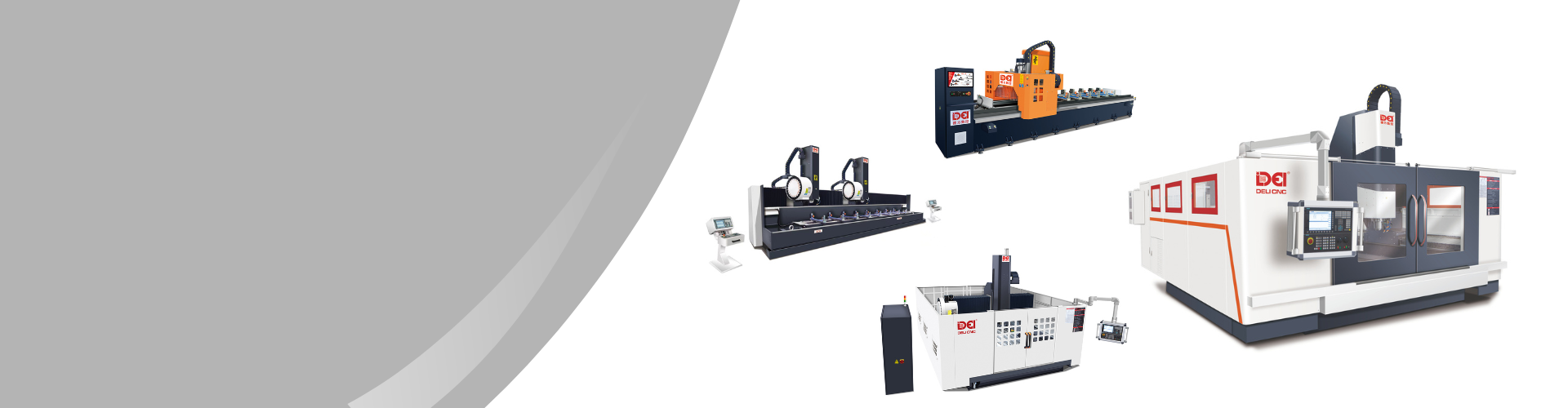
DELICNC sets clamp pressure per zone and records it, so the next operator repeats the same hold. DELICNC 4-axis aluminum profile machining centers are built around this idea. They pair a long T-slot bed with pneumatic clamp rails spaced for typical profile lengths, and the 4th axis lets the part stay clamped while the head mills the sides. The clamping is part of the machine, not an afterthought bolted to a table.
Vacuum Zoned Fixturing for Thin Plates
A thin plate cannot be held by edge clamps alone. The unsupported center will bow the moment the cutter loads it. What holds a plate flat is support across its whole face, and the cleanest way to get that is a vacuum table with independently switched zones.
The rules that make vacuum work on aluminum:
Map the zones to the part outline. Open only the zones that sit under the part. A zone with no part over it just leaks air.
Seal the perimeter. A perforated vacuum plate needs edge tape or a gasket so the seal forms before the pump pulls.
Close zones you are not cutting over. If a zone under the active cut stays open, the plate lifts exactly where you need it flat.
Keep the seal continuous. A single gap in the perimeter drops hold across the whole table.
DELICNC gantry machining centers and curtain wall fabrication equipment handle large vacuum tables well, because both work on panels wider than a vertical machining center can reach. DELICNC ships these machines vacuum-ready, with the plenum and zone valves already matched to the table. One more point on plates: the raw blank must already be flat where it meets the table. A plate that is waved across its face will never seal, no matter how strong the pump. Inspect the blank before you trust the vacuum. The gantry span gives the table room, and the rigidity keeps the cut steady while the vacuum does the holding.
Support Spacing Controls Flatness More Than Clamp Force
Operators often fight flatness by cranking clamp pressure. On long profiles and thin plates, spacing is the lever that moves the number. For a long profile, the gap between supports decides how much the span flexes under the cut. Close those gaps and the part stops moving. For a thin plate, it is the vacuum zone pitch, not the clamp count, that sets flatness. A simple way to see it: a three meter profile spanned at one meter gaps will flex far more under the same cut than the same profile spanned at four hundred millimeter gaps. The cut force does not change. Only the distance between supports changes, and that distance sets how much the span gives. Close the gaps before you touch the pressure dial.
The datum choice matters too. Pick one primary datum face and one end, and locate the part there every time. Never locate on a surface you are about to clamp, because the clamp will move the datum and the part will drift. DELICNC fixture standards call for a single defined datum chain on long work so two shifts produce the same part. DELICNC operator training stresses spacing over force, because force fights a symptom while spacing fixes the cause.
The Clamp Sequence That Prevents Twist
Twist shows up after unclamping. The part measured flat while clamped, then sprang into a helix the moment it was released. The cause is almost always clamp order and pressure imbalance.
A repeatable sequence removes it:
Rest the profile on its supports first, so it sits in free state.
Locate against the primary datum before any clamp touches it.
Pre-clamp at the datum end lightly.
Work outward, clamping each zone to equal pressure.
Document the sequence. When one operator clamps end-first and another clamps middle-first, the finished dimensions will not match.
For tight tolerance, relax and re-seat before finishing. The second clamp sits on a relaxed part, not one already bent by the first hold.
This two-stage relax is the same principle DELICNC applies on thin-wall aluminum: enough holding force to cut, never enough to bend. DELICNC standard work instructions put the relax-and-reseat step in writing for any profile above a set length.
How the Machine Design Enables the Clamping
Clamping is not separate from the machine. The machine sets what clamping is even possible, and DELICNC designs its lines around the hold each one needs. Rigidity is the quiet partner of clamping. A bridge that deflects under load pushes the cutter into a vacuum-held plate and ruins the very flatness the vacuum was meant to protect.
A DELICNC 4-axis profile machining center holds the part along its length on a T-slot bed with pneumatic rails, then rotates it to cut the sides without re-fixture. For long extrusions this is the standard answer, and the are built for exactly this work.
A DELICNC spans wide and stays rigid, which is what lets a large vacuum table sit underneath a thin plate without the bridge deflecting into the cut.
DELICNC is sized for the long mullions and large panels that define facade work, where profile and plate fixturing meet on one line.
A DELICNC handles short profiles and smaller plates with a vise or fixture plate, but its envelope limits how long a part can stay supported.
Buying the machine without thinking about the hold is how shops end up with a rigid spindle and a part that still moves.
Common Mistakes That Ruin Long and Thin Aluminum
Clamping a long profile only at both ends. The middle twists.
Over-clamping plate edges. The part bows after release.
Leaving a vacuum zone open under the cut. The plate lifts on the finish pass.
Clamping both ends of a long profile and ignoring thermal growth. The part bows as it warms.
Locating on a clamped surface. The datum drifts and so do the dimensions.
Trusting one operator's feel. Without a written sequence, the part changes with the shift.
Using profile rules on a plate, or plate rules on a profile. The two holding systems are not interchangeable.
Assuming more clamp force fixes twist. Extra pressure only bends the part harder and hides the real cause.
DELICNC application engineers see these mistakes more than any other on profile and panel lines, and almost all of them trace back to the hold, not the machine. DELICNC field reports put the cost in scrap and rework, not in machine faults.
Pre-Cut Checklist
DELICNC stores both checklists at the machine so the sequence is followed, not remembered.
For a long profile:
Supports run along the full length?
Located on primary datum before clamping?
Zones clamped outward at equal pressure?
Far end left free for thermal growth?
Sequence written down and followed?
For a thin plate:
Vacuum zones mapped to the part outline?
Perimeter sealed, open zones closed?
Zone under the active cut kept closed?
Datum face defined and not clamped?
FAQs
Can I just hold a long profile in a vise?
Only the very end. The rest of the length needs support and clamping or it twists. A vise alone is for short parts.
Vacuum or clamps for a thin plate?
Vacuum for large flat panels, because it supports the whole face. Edge clamps alone bow the middle. DELICNC plate fixtures use full-face vacuum for this reason.
How much clamp force is right?
Enough to resist the cut, not enough to distort the part. The check is spring-back: if the part moves when released, the clamp was too tight.
When does a 4-axis profile center beat a 5-axis one?
When the work is long extrusions cut mostly on sides and ends, the 4-axis profile center holds the part better and costs less. The profile machining center selection guide covers the trade in detail.