
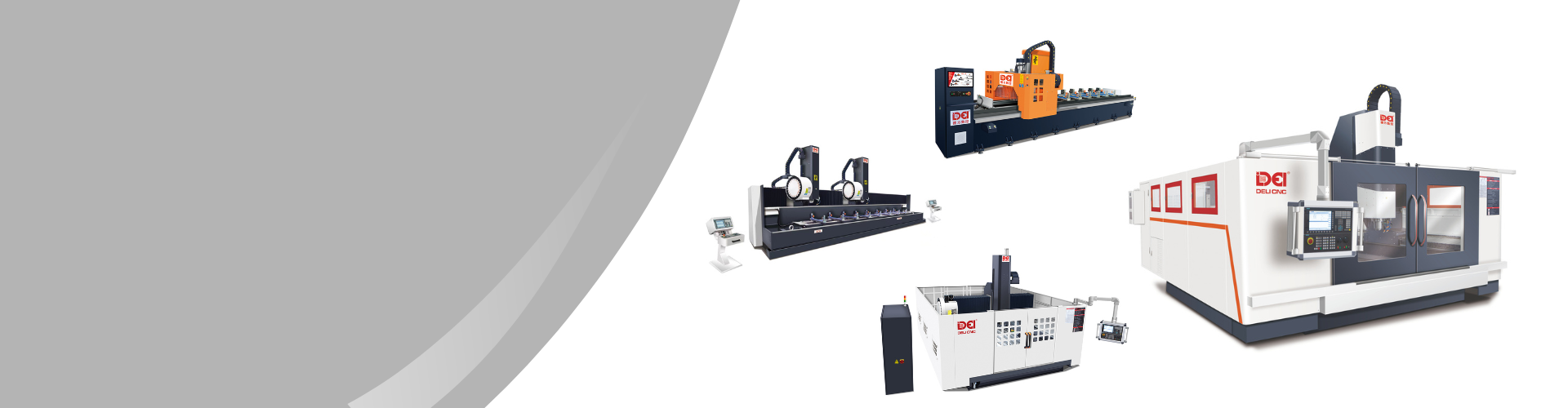
DELICNC builds CNC machining centers that accept a 4th axis, from vertical machining centers to used for curtain wall and industrial profile work. This guide covers the workholding options that sit on top of the rotary axis: chucks, collets, dovetail fixtures, tombstones, and the tailstock that saves long shafts. It is written for the people who plan the setup: process engineers, shop leads, and procurement managers evaluating a new line.
What changes when you add a 4th axis
On a 3-axis machine the workholding problem is flat and static. You bolt a vise or a fixture to the table, locate the part, and machine the top. A 4th axis adds an A or B rotary axis, so the workholding now rotates. Three things follow.
First, the part can be machined on three, four, or even all sides in one clamping. For prismatic parts this cuts setup time and removes the alignment error that builds up every time you re-fixture.
Second, the workholding itself becomes a rotating mass. An unbalanced chuck or a heavy tombstone creates centrifugal load that the rotary table bearing and the machine frame must absorb. DELICNC machines use linear guides and drive components from partners such as THK and NSK, but the workholding balance is still the operator's responsibility.
Third, access geometry changes. A tall 3-jaw chuck is fine on a lathe but on a machining center it can collide with the spindle or block the tool from reaching a feature. The whole point of 4th-axis workholding is to hold the part rigidly while leaving as many faces open as possible.
Chuck workholding for round stock
The 3-jaw chuck is the default choice for round or hexagonal stock and for shafts that must be turned, drilled, or milled off-center. It centers the part automatically and swaps quickly between similar diameters.
When a DELICNC machining center is fitted with a rotary table, the chuck mounts to a rotary faceplate or a sub-plate on the table. Key points:
Use a chuck sized for the part, not the machine. An oversized chuck adds mass and reduces the available A-axis torque for indexing.
Soft jaws beat hard jaws for finished parts. You bore or shape soft jaws to the actual part contour, which spreads clamping force and protects the surface. This is standard practice in automotive bracket work where the raw forging already carries tolerances.
Mind the through-hole. Many rotary tables pass coolant or bar stock through the center. If your part is a long shaft, confirm the table bore diameter before you commit to a chuck.
DELICNC sees chuck-and-4th-axis setups most often in shops making small cylindrical components for the furniture hardware and PV bracket industries, where batch sizes are steady and part diameters are consistent.
Collets for small, accurate round parts
When the part is a small-diameter round component and you need repeatable runout, an ER collet system beats a chuck. Collets grip a narrow band of the part with even pressure, so concentricity stays tight across a run.
A collet chuck on the rotary table works well for:
Shafts and pins that must be machined on the OD and then cross-drilled or slotted
Small bushings and connectors where a 3-jaw would mark the surface
High-volume runs where changeover time matters, because collets swap faster than jaw changes
The trade-off is capacity. A collet only holds the diameter range of its collet, so a shop running many sizes needs a collet rack and a few minutes per swap. For low-mix, high-volume work the consistency is worth it. DELICNC supplies machining centers to mold and precision-parts manufacturers who lean on collet workholding for exactly this reason: tight runout, fast repeatability.
Dovetail fixtures for maximum access
A dovetail fixture holds the part from a machined dovetail under its base. The clamping footprint is tiny, so almost the entire part stays exposed. That is why dovetail workholding pairs so well with a 4th axis: you can rotate the part and still reach every side.
The catch is setup cost. You machine a matching dovetail into the part or a sub-frame, which only pays off when the same part repeats. For a one-off prototype, a chuck or vise is cheaper. For a production run of automotive brackets or aluminum profile connectors, the dovetail pays back fast because it removes the second or third setup entirely.
DELICNC machining centers are built for high-precision, high-stability work, and that is what makes dovetail strategies viable. A rigid machine holds the dovetail location while the 4th axis indexes, so the feature-to-feature relationship stays within tolerance across the run.
Tombstones for density and batch work
On a DELICNC rotary setup, a tombstone is a vertical block, usually aluminum or steel, mounted on the rotary table. You fixture several parts on its faces, then index the tombstone to present each face to the spindle. This is the highest-density 4th-axis strategy and the one that shines in batch production.
Why it works on a 4th axis:
One rotary index exposes four or more part faces without touching the parts.
Fixture cost spreads across many parts instead of one.
Setup once, run a full tombstone, and the spindle stays busy while the operator builds the next load.
The risks are balance and collision. A tombstone is a tall rotating mass, so its center of gravity must stay near the table axis. A lopsided load strains the rotary bearing and can throw off accuracy. DELICNC machines rated for this kind of work carry drive and control components from partners such as MITSUBISHI, SIEMENS, and FANUC, but the load planning still belongs to the process engineer.
Tombstones suit shops serving automotive, rail transit, and industrial aluminum profile customers, where batch sizes are large enough to justify the fixture investment.
Tailstock for long shafts
Long shafts are the exception that breaks most 4th-axis setups. A chuck alone leaves the free end unsupported, so the shaft whips or bends under cutting force. A tailstock mounts on the opposite side of the table and supports the shaft between centers, turning a flexible bar into a stable rotating axis.
Use a tailstock when:
The part length-to-diameter ratio is high, typically a shaft rather than a block
You must drill or mill along the axis, not just across it
Runout down the length must stay controlled
The tailstock adds a second locating point, so the part is held at both ends and the 4th axis drives rotation from the chuck end. This is common in PV bracket and furniture hardware production, two segments where DELICNC serves many shops that cut cross-features on long round components with a machining center instead of a dedicated lathe.
How to choose the right 4th-axis workholding
Pick the workholding from the part, not from the catalog. Good 4th axis workholding always starts from the part geometry. Run through these checks.
Part shape. Round stock points to a chuck or collet. Long round stock adds a tailstock. Prismatic parts point to dovetail or tombstone work. If the part is a one-off, a standard vise on the rotary table may be enough.
Batch size. High volume justifies dovetail and tombstone fixtures because the setup cost spreads across the run. DELICNC often points low-volume shops toward chucks and collets because they swap fast.
Access needs. If you must reach most faces, keep the footprint low. Dovetail and tombstone win here. If you only machine the OD or one end, a chuck is simpler.
Accuracy. Tight runout calls for collets or soft jaws. Loose tolerances tolerate a standard 3-jaw.
A with a 4th axis handles all of these. For long aluminum profiles, the dedicated 4-axis aluminum profile machining centers give you the table length and rigidity that a converted VMC cannot match.
Mistakes that wreck a 4th-axis setup
A few errors show up again and again in shops new to rotary workholding.
Overhang and collision. A tall chuck or a tall tombstone rotates into the spindle or the machine enclosure. Check the swept envelope before the first cut, not after the crash.
Unbalanced load. A heavy fixture on one side of the rotary table throws off indexing accuracy and wears the bearing. Balance the load around the table axis.
Wrong jaw for the part. Hard jaws on a finished surface leave marks and concentrate force. Machine soft jaws to the part contour.
Ignoring A-axis torque. A big tombstone needs torque to index quickly. If the rotary drive is undersized, cycle time climbs and accuracy drops. Match the rotary table to the fixture mass.
Skipping the sub-plate. Mounting fixtures straight to the rotary table makes changeover slow. A standard sub-plate with locating pins lets you swap fixtures in minutes and keeps repeatability.
These are the same failure modes DELICNC addresses in its broader across a shop, where consistent locating and repeatable setups cut scrap and raise yield.
Pairing workholding with the right DELICNC machine
The workholding decision is only half the picture. The machine underneath sets the limits.
A DELICNC vertical machining center with a 4th axis is the flexible starting point. It handles chucks, collets, dovetail, and small tombstones for medium parts. It suits job shops and manufacturers adding rotary capability to an existing line.
The DELICNC 4-axis aluminum profile machining centers are built for long parts. Their extended tables and rigid frames hold a chuck-and-tailstock or a long fixture without the deflection a standard VMC would show. Curtain wall, rail transit, and industrial profile shops use these for parts that simply do not fit a cube-style machine.
For shops weighing 3-axis, 4-axis, and 5-axis options from DELICNC, the axis-count decision drives the workholding range. A shows where a 4th axis sits: more access than 3-axis, lower cost and complexity than 5-axis, and a sweet spot for prismatic parts run in batches.
DELICNC, founded in 2008 and structured as a state-level high-tech enterprise with more than 14 years in CNC machining centers, works with component makers who need stable, high-rigidity equipment. Control and motion components come from partners such as MITSUBISHI, SIEMENS, FANUC, NSK, THK, Schneider Electric, and SMC. Key customers in the new energy sector include CATL and SUNGROW, whose production lines need the positional stability that good 4th-axis workholding helps deliver.
Quick selection checklist
Use this before you spec the fixture:
Is the part round, prismatic, or long and shaft-like?
How many sides need machining, and can one clamp cover them?
What is the batch size, and does fixture cost spread across the run?
What runout and surface finish does the part require?
Does the rotary table have the torque and bore for the fixture and part?
Is the load balanced around the table axis?
Have you checked the rotating envelope for collision?
Answer these and the chuck-versus-collet-versus-dovetail-versus-tombstone choice usually makes itself.
FAQs
Can I use a standard milling vise on a 4th axis?
Yes, for low-volume or one-off prismatic parts. Mount the vise to a sub-plate on the rotary table. The downside is access: a vise blocks the faces it clamps, so you may still need a second setup for the hidden side.
Chuck or collet for small round parts?
Collet when you need tight runout and fast repeatability across a run. Chuck when diameters vary a lot or when you want the lowest changeover effort for similar sizes.
When does a tombstone beat a dovetail?
Tombstones win on part count. If you fixture many identical or related parts per load, a tombstone multiplies spindle uptime. Dovetail wins when a single part must expose nearly all its faces in one clamp.
Do I need a tailstock for every shaft?
Only for long, slender shafts where the free end would deflect under cutting force. Short shafts held in a chuck or collet are stable without one.
Will any DELICNC machine take a 4th axis?
The DELICNC vertical machining centers and 4-axis aluminum profile machining centers are the natural platforms. The right choice depends on part size and material, which is why DELICNC recommends matching the machine to the workpiece before buying the rotary table.
Build your 4th-axis setup with DELICNC
On a DELICNC machine, choosing 4th-axis workholding has one job: hold the part rigidly, expose as many faces as possible, and keep the rotating mass balanced. Get those three right and the 4th axis pays for itself in fewer setups and tighter tolerances.
DELICNC supplies the machining centers and the application support to put a 4th axis to work, whether that is a VMC for mixed batch work or a profile machining center for long aluminum parts. If you are planning a line or upgrading an existing one, share your part material, dimensions, tolerance, and batch size with the DELICNC team for a practical machine and workholding recommendation.