
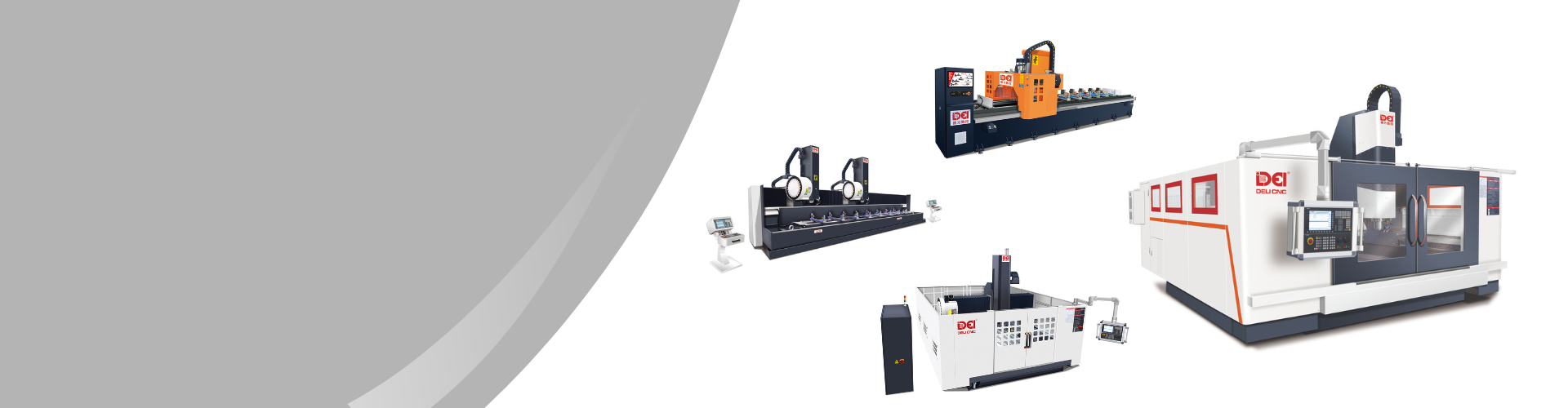
and the broader CNC vertical machining center range that DELICNC has been building for automotive, new-energy, aerospace, and curtain-wall manufacturers for more than 14 years.
This guide covers what a three-axis (3-axis) CNC system actually is, what it can and cannot do, and how it stacks up against 4-axis and 5-axis setups. The part that matters most if you are buying: how to tell whether a 3-axis vertical or gantry machining center is the right spend for your parts, materials, and volumes.

What Is a Three-Axis (3-Axis) CNC System
A three-axis system is the basic motion-control setup in CNC machining. The machine positions the cutting tool, or the workpiece, along three straight axes at the same time:
X-axis: left–right (horizontal table travel)
Y-axis: front–back (horizontal saddle travel)
Z-axis: up–down (vertical spindle travel)
Servo or stepper motors drive the motion, and a CNC controller running G-code plots the path. The machine moves the tool through 3D space to mill, drill, tap, bore, and engrave. The one thing that defines a true 3-axis system is that only these three linear axes move during the cut. There is no rotary A, B, or C axis tilting or flipping the part mid-job.
That limitation is also the reason 3-axis machines are so common. They are mature, reliable, quick to program, and much cheaper than multi-axis options for most flat, prismatic, and 2.5D parts. I say "most" because there is a real edge case, and we will get to it.
Core Components of a 3-Axis CNC Machining Center
A three-axis system is more than a moving table with a spinning tool. The subsystems below are what decide whether you hit accuracy and keep the machine running:
CNC Control System (Controller): Reads the G-code and sends motion commands. Industrial platforms such as FANUC, SIEMENS, and MITSUBISHI sit inside DELICNC's supplier network and give the closed-loop stability you need for micron-level repeatability.
Drive Motors & Amplifiers: The X/Y/Z servo motors supply force and feedback. Closed-loop servo systems stop lost steps and hold accuracy under load.
Transmission Mechanism: Ball screws and linear guideways from NSK, THK, and similar suppliers turn motor rotation into smooth, rigid linear travel.
Spindle Motor: Powers the cutting tool. Spindle power and speed set how hard you can cut aluminum, steel, or composites, and which tools fit.
Human-Machine Interface (HMI): The panel and software where operators set parameters, jog axes, and watch status.
CAM Software: Turns your CAD model into toolpaths (G-code). Mastercam and Fusion 360 are still the standard choices for 3-axis programming.
What Can a 3-Axis CNC Machine Do
Three-axis CNC machining covers most of the 2D and 2.5D work you will see in metal fabrication and precision parts shops:
Surface & Face Milling: Shaping faces, datums, and end surfaces.
Drilling & Tapping: Vertical holes and threads in metals, plastics, and composites.
Engraving & Relief Carving: 2.5D text, nameplates, mold textures, and decorative panels.
Edge Processing: Chamfering, slotting, contour trimming, and boss milling.
The Role of 2.5D Machining
"2.5D" is work where the tool moves freely in the X/Y plane but cuts in layers along Z. Pocketing a mold cavity, engraving a logo, or cutting a groove profile all fall here. Three-axis systems do 2.5D work well, and for most production parts, 2.5D covers nearly everything you need.
Industries That Rely on 3-Axis CNC Machining
Because 3-axis platforms are mature, stable, and cheap to own, they show up in almost every industry DELICNC serves:
Automotive & EV Battery Trays: Structural aluminum parts, mounting brackets, and battery-tray components. Large thin-wall aluminum trays warp easily, and that is the real fight. DELICNC's work pairs 3-axis roughing with a rigid gantry to hold flatness.
Aerospace: Fixture details, prototypes, and simpler structural parts where tight tolerance matters more than cutting all five sides at once.
Curtain Wall & Window/Door: Aluminum mullions, transoms, and façade frames are mostly 2.5D prismatic profiles. They suit 3-axis work and the dedicated that drills, mills, and cuts in one pass.
Furniture & Custom Home: Panel shaping, door engraving, and aluminum frame production.
5G & Electronics: Housings, panels, and heat-sink machining.
Mold & Precision Parts: Plastic molds, stamping dies, and aluminum tooling.
3-Axis vs 4-Axis vs 5-Axis: When Are Three Axes Enough
Production and engineering directors ask this a lot. My honest answer: most parts do not need more than three.
3-axis covers the bulk of flat, prismatic, and 2.5D features at the lowest cost and the fastest programming.
4-axis adds a rotary A-axis, usually a trunnion or rotary table, so you can machine around a cylinder or index a part to several faces without re-clamping.
5-axis adds tilt, letting the tool hit complex surfaces from any angle. That is what impellers, turbine blades, and freeform molds need.
More axes mean a higher machine price, harder programming, and operators who actually know the system. For high-mix, low-to-medium-volume prismatic parts, 3-axis is usually the better capital call. When the real question is 3-axis vs 5-axis, the answer almost always comes down to part shape, not budget. If curved surfaces are on your roadmap, our deeper comparison lays out exactly when to move up.
Choosing Between a 3-Axis Vertical and Gantry Machining Center
Once you settle on three axes, the next question is the machine shape:
Factor Vertical Machining Center (VMC) Gantry Machining Center Best workpiece size Small to medium parts Large, long, or heavy plates Footprint Compact, easy cell integration Larger, bridge/portal structure Rigidity under load Excellent for standard parts Superior for wide-span cutting Typical use Precision parts, molds, brackets Battery trays, long profiles, ship/aero panels
DELICNC's vertical lines (SCH, SCD, HA, HB, and the double-column SCA) handle precision parts and mold work. The and the mid-size MD-Z-3020 go after large non-ferrous parts like EV battery enclosures and 5G housings. Pick based on your largest part and your target cycle time, not on which machine looks more impressive in a brochure.
Key Performance Parameters to Evaluate
When you compare 3-axis machines, look at the numbers that change your output:
Repeat Positioning Accuracy: Decides whether you hold tolerance shift after shift.
Maximum Travel (X/Y/Z): Has to clear your largest workpiece plus fixturing.
Spindle Power & Speed: Sets material removal rate and tool compatibility.
Feed Rate & Acceleration: Drives cycle time and surface finish.
Closed-Loop Control: Servo feedback stops lost steps and drift under cutting load.
Structural Rigidity: Box-way versus linear-guide, single versus double column. This is what keeps thin aluminum from deforming.
These are the specs where buyers quietly lose cycle time and scrap rate. Our breaks down five ways to raise precision, tool life, and throughput on a vertical machining center.
How to Choose the Right 3-Axis CNC System
A short checklist for production directors, engineering managers, and procurement leads:
Define the part envelope: longest X/Y/Z dimension plus fixture allowance.
Match material to spindle: aluminum wants high RPM; steel wants torque and rigidity.
Count your features: if most are 2D/2.5D, 3-axis is enough; save 4/5-axis for true freeform work.
Verify software compatibility: make sure the controller takes your CAM output and any future MES/Industry 4.0 link.
Plan for support: confirm spare parts, commissioning, and how fast local service responds.
Design for growth: check expandability (rotary 4th axis, automatic tool changer, loading/unloading).
FAQs
Is a 3-axis CNC enough for most parts?
Yes. Most production parts are flat, prismatic, or 2.5D, and three-axis machines handle those with the best speed-to-cost ratio. Move to 4- or 5-axis only for cylindrical indexing or complex freeform surfaces.
What is the difference between a 3-axis VMC and a 3-axis gantry?
A CNC vertical machining center fits small-to-medium parts in a compact cell. A gantry machining center uses a bridge structure for better rigidity on large, long, or heavy workpieces like EV battery trays and long aluminum profiles.
Can a 3-axis machine handle aluminum without deformation?
It can, if the structure is rigid and the cutting parameters are set right. For thin-wall aluminum such as battery trays, a rigid gantry plus correct feeds and speeds is the standard way to keep deformation down.
Which controller should I choose for a 3-axis CNC?
Base it on your machining needs, operator experience, and budget. FANUC, SIEMENS, and MITSUBISHI give proven closed-loop stability and broad support, which matters in production where downtime is expensive.
Conclusion
A three-axis CNC system is the default choice in manufacturing for good reason. It covers flat cutting through 2.5D shaping at a fraction of multi-axis cost, and it stays the dependable option for small businesses, prototype work, and high-mix prismatic runs. Good programming, solid CAM practice, and a rigid machine structure get you micron-level precision on parts from aerospace panels to automotive brackets.
Talk to DELICNC about your parts.