
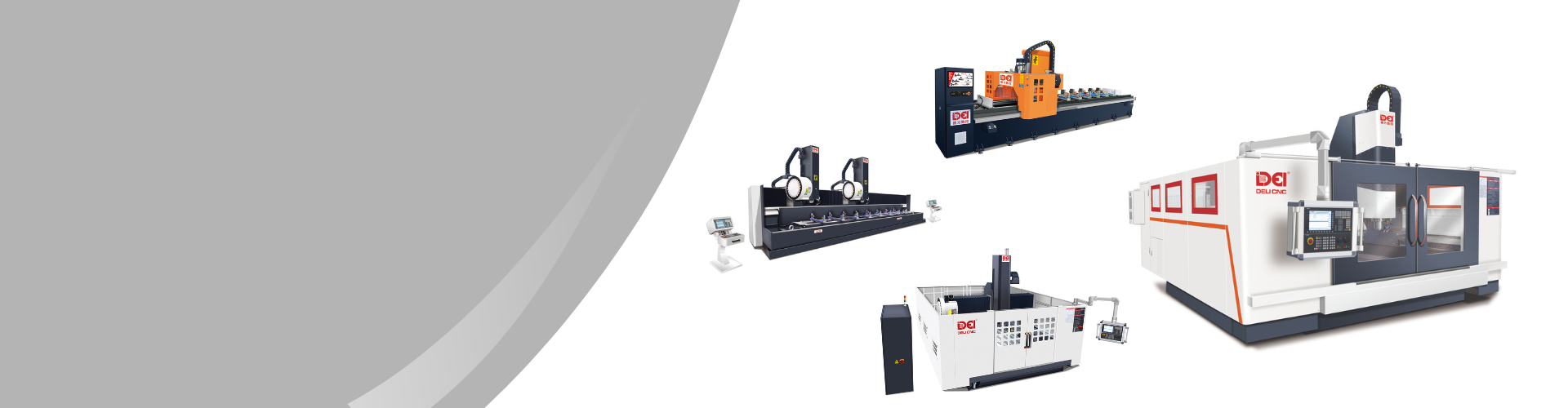
DELICNC started in 2008 as a state-level high-tech enterprise and has spent 14+ years building CNC machining centers. The company supplies automotive, EV battery tray, aerospace, rail transit, 5G, and curtain wall manufacturers around the world. This guide walks through six machine shop tools that matter, looked at through DELICNC's own engineering practice, so production directors, engineering managers, and procurement leads can plan a workshop that holds tolerance and hits cycle time.

The CNC vertical machining center: your precision core
The CNC vertical machining center sits at the center of most precision shops. DELICNC's VMC line includes the 4-axis MDF series, which uses a double-arm movable column and a high-performance electrospindle. That combination gives the rigidity and repeatability you need for molds, precision parts, and structural aluminum.
The machine only gets you so far. The real gains come from how you set it up: the parameters you run and the tooling you choose.
Cutting smarter
Program the G-code, but don't stop at basic contours:
Climb milling keeps tool wear down and finish up.
Helical interpolation spreads cutting force evenly on deep holes.
Adaptive clearing holds a constant chip load and typically lifts efficiency 10 to 20 percent.
Shaping complex geometries
Aerospace brackets, medical fixtures, anything with 3D contours needs the right cutter:
Ball nose end mills for finishing. Keep stepover at 0.2 mm or less to reach Ra 0.8 μm.
Flat end mills for fast 2D work. Run a high-feed strategy (ap 0.3 to 0.5 mm, fz 1.2 mm/tooth or more).
DELICNC's parameter framework
| Parameter | Aluminum alloy | Steel | Titanium alloy |
|---|---|---|---|
| Cutting speed (Vc) | 200 to 400 m/min (300 is the sweet spot) | 50 to 150 m/min | 20 to 60 m/min |
| Feed per tooth (fz) | Rough 0.1 to 0.3 / finish 0.05 to 0.15 mm/tooth | Same as aluminum, lower Vc | Shallow multi-pass, fz under 0.1 |
| Depth of cut (ap) | Rough 1 to 2x tool dia / finish 0.1 to 0.5 mm | Same | ap 0.5 mm or less per pass |
One aerospace shop cut Vc from 50 to 30 m/min on Inconel. Tool life went up 40 percent and total machining time dropped 15 percent.
Tooling and integration essentials
Coatings: TiAlN shrugs off heat on stainless (about 30 percent more tool life); DLC stops aluminum sticking.
Tool holders: HSK for 5-axis high-speed work, BT for general jobs.
Preset and compensate: measure tools on a presetter (±0.02 mm) and load offsets into the D-codes.
Tool life management (TLM): track usage by RFID or cycle count so a tool doesn't fail mid-run.

The CNC gantry machining center: large parts, real rigidity
When a part grows past a VMC's travel, say an EV battery tray, a long rail-transit aluminum profile, or an aerospace panel, the CNC gantry machining center is the tool. DELICNC's double-column, moving-column gantry stays rigid under load, which keeps vibration down during aggressive material removal.
Big aluminum parts twist from heat and clamping stress. DELICNC's 5-axis gantry (MDF series, HSK A63) machines complex profiles in one clamping, so you avoid stacking errors across setups. That matters for EV battery tray machining, where flatness and weld-prep quality decide whether the part fits downstream.
The vertical machining center vs gantry call usually comes down to size. A gantry earns its place when the part won't fit a VMC or when you need double-column rigidity to cut cleanly at high removal rates.
Why a gantry wins on big parts
Rigidity: the double-column frame soaks up cutting forces better than a single-column VMC.
Envelope: it takes parts a vertical center simply can't.
5-axis machining in one setup: compound-angle milling without accumulating tolerance.
Throughput: high-torque spindles keep removing material fast on aluminum and composites.
For large aluminum structures, run the gantry with thermal deformation compensation and symmetric clamping. That holds flatness to within microns.
Curtain wall fabrication equipment and double-head saws: profiles and volume
Not every DELICNC customer needs a 5-axis center on day one. A lot of window, door, and curtain wall fabricators, furniture shops, PV bracket makers, and industrial aluminum profile processors mostly want fast, accurate aluminum profile cutting and fabrication. Two DELICNC lines handle exactly that.
The curtain wall CNC fabrication equipment works mullions and transoms with compound-angle cutting, multi-face drilling, and milling in one pass. The double head sawing machine cuts high volumes of aluminum extrusions at repeatable angles, which is what mass curtain wall and furniture frame production leans on.
How fabrication workflows fit together
| Operation | DELICNC equipment | Typical use |
|---|---|---|
| Compound-angle cutting | Curtain wall CNC center | Unitized curtain wall mullions |
| Multi-face drilling and milling | Curtain wall CNC center | Window and door profiles, PV brackets |
| High-volume extrusion sawing | Double head sawing machine | Furniture frames, aluminum sections |
| Automated sawing lines | Double head saw + conveyor | Rail transit long aluminum parts |
Shops moving from manual cutting to automated lines cut setup time and scrap when they link a double-head saw to a profile machining center.
Measurement and quality control: the eyes of the process
You can't call a part precise if you never measure it. DELICNC builds for micron-level precision, but automotive, aerospace, and medical supply chains still need a layered check, not a single gauge.
A four-tier measurement system
Shop-floor checks: digital calipers (±0.01 mm) and micrometers (under 0.001 mm) on critical features.
Setup and alignment: edge finders pin part zero to ±0.005 mm; machinist's squares confirm 90 degrees.
In-process control: dial and digital indicators read runout and flatness; in-machine probes measure, compensate, and close the loop.
Final validation: a CMM confirms full GD&T; profilometers check the Ra surface finish (target Ra 1.6 μm or better).
If Ra runs above 1.6 μm, slow the feed or change the tool. Don't ship a part you know is off.
Deburring and finishing: safety and consistency
Burrs hurt people, wreck assemblies, and shorten fatigue life. On DELICNC cells, deburring is programmed, not done by hand.
| Burr type | Fix | Where it fits |
|---|---|---|
| Edge burrs | Chamfering tools | Add a G01 chamfer at the end of the CNC program |
| Internal burrs | Deburring drills | Run with the drilling cycle |
| Complex contours | Brush or vibratory systems | A post-machine automation cell |
Aerospace and EV battery tray makers now require automated deburring. It protects operators and keeps parts consistent.

Smart systems: when tools start talking to each other
Better machines help. Connected machines change the game. DELICNC works as a manufacturing partner, not just an equipment supplier, and the integration layer is where that shows.
Three ways integration pays off
Adaptive control systems (ACS): sensors watch cutting force, vibration, and temperature, then nudge Vc and feed in real time. On turbine blades that stretched tool life about 30 percent.
Robotics and automation: arms load, inspect, and pack; automated vises and door control take the operator out of the loop.
Data you actually use: log material, tool, Vc, feed, ap, and tool life. One shop cut tool changes 20 percent and raised efficiency 15 percent just by reviewing the log each quarter.
One EV battery tray maker ran 16 hours continuous with 80 percent less hands-on time by tying gantry machining, in-machine probing, and tool life management together. That is the lights-out production goal most shops talk about but few reach.
A buyer's checklist before you spec equipment
Walk through this with engineering and procurement before anyone quotes a machine. It mirrors how DELICNC scopes a job in a technical consultation:
Workpiece envelope: max length, width, height. Does it need a VMC or a gantry?
Material mix: aluminum, steel, titanium, composites. This sets spindle, coolant, and coating.
Tolerance and finish: target Ra, GD&T, and how you'll inspect (probe or CMM).
Batch profile: high-volume simple parts favor sawing and fabrication lines; low-volume complex parts favor 5-axis centers.
Automation readiness: do you want robotic loading, tool life management, and MES or Industry 4.0 links from the start?
Total cost of ownership: not just the sticker. Tooling, energy, maintenance, and downtime all count.
Supplier support: local commissioning, spare parts, and how fast they answer.
For automotive and aerospace work, lead time and how the machine drops into your existing line often decide ROI faster than the headline price.
FAQs
What are the six most essential machine shop tools for a modern CNC workshop?
From DELICNC's engineering practice, the six are:
CNC vertical machining center: the precision core for molds and parts.
CNC gantry machining center: large parts like EV trays and rail aluminum.
Curtain wall fabrication equipment and double-head sawing machines: profile cutting and fabrication.
Measurement tools: calipers, micrometers, CMMs, in-machine probes (Ra 1.6 μm).
Deburring tools: automated chamfering and brush systems.
Smart integration: tool life management, adaptive control, and robotics.
They form a loop: machine, measure, refine, automate.
How do I choose between a vertical machining center and a gantry machining center?
Match the machine to the part's size and the rigidity you need.
VMC: molds, precision parts, medium aluminum where floor space and budget matter.
Gantry: large parts (EV battery trays, long rail profiles, aerospace panels) that exceed VMC travel, or where double-column rigidity kills vibration at high removal rates.
Quick rule: if a part needs several setups on a VMC or it keeps distorting, move to a gantry.
How do I stop large aluminum parts like EV battery trays from distorting?
Large aluminum warps from heat and clamping. DELICNC's approach:
Machine on a 5-axis gantry in one clamping, so setup errors don't stack.
Use thermal-deformation compensation with symmetric, low-distortion clamping.
Ease the parameters: moderate Vc, shallow multi-pass ap, high-pressure coolant.
Check flatness with an in-machine probe before you unclamp.
Can a CNC machining center replace a drill press or a saw?
Yes, up to a point.
Upside: multi-axis positioning, helical interpolation for deep holes, automated patterns.
Downside: swapping to small tools constantly slows you down, and deep holes still need G83 peck drilling.
What works: keep a dedicated double-head saw for high-volume profile cutting and use the CNC center for complex or tight-tolerance holes. About 70 percent of DELICNC customers run both, each doing the job it's good at.
How do I get to lights-out production?
Three things have to line up:
Hardware: robotic load and unload, automated vises, CNC door control.
Software: tool life management (RFID or cycle count) and adaptive control for live feed and speed changes.
Process: build deburring, in-machine probing, and compensation into the end of the CNC program.
Where should a beginner start with CNC parameters?
Three steps:
Start from baselines: aluminum Vc 300 m/min; stainless Vc 30 m/min, fz 0.1 mm/tooth.
Run small batches and measure tool wear, Ra surface finish, and cycle time.
Keep a parameter log and review it every quarter.
Wrapping up
Those six tools, a vertical machining center, a gantry, curtain wall fabrication and sawing gear, a measurement setup, a deburring step, and a smart integration layer, give you a workshop that can hold tolerance and scale. The machine is only as good as the parameters, the tooling, and the data you keep on it.
Start where the manufacturer suggests, then test, measure, and tune. Use CAM simulation, in-machine probing, and tool life management. And talk to a supplier who brings process know-how, not just iron. DELICNC does both: the machines and the engineering to make them pay.