
CNC Precision Machining: VMC vs Gantry vs 5-Axis
CNC precision machining line is rarely about buying the most expensive machine. It is about matching architecture, axis count, and rigidity to the workpiece in front of you — its material, its size, its tolerance, and your batch volume. Get that match wrong and you absorb the cost for a decade: scrap from vibration, distortion in thin aluminum, thermal drift that ruins a long aerospace run, or a gantry that arrives six months late because no one planned the foundation.
DELICNC has spent 14+ years as a state-level high-tech enterprise building exactly these machines — CNC vertical machining centers, CNC gantry machining centers, 5-axis profile machining centers, curtain wall CNC fabrication equipment, and double-head sawing machines — for automotive, EV, aerospace, rail transit, 5G, and curtain-wall manufacturers. This guide walks through the engineering logic we use when helping a production director or process engineer select the right solution, so you can shortlist with confidence before you ever request a quote.
Understanding CNC Precision Machining: What It Is and Why It Matters
A CNC machining center is a computer-controlled milling platform that performs drilling, tapping, boring, and contouring in a single setup under programmed tool paths. "Precision" is not a marketing word here — it is a measurable stack of capabilities: positioning accuracy (how close the tool lands to the commanded point), repeatability (how consistently it returns), geometric accuracy (straightness, squareness of the axes), and thermal stability (how little the frame drifts as it warms up).
Why it matters: in EV battery trays and aerospace brackets, a 0.05 mm deviation propagates into assembly failure. In curtain-wall mullions, an angular error of 0.1° becomes a visible gap on a 30-meter façade. Micron-level precision control

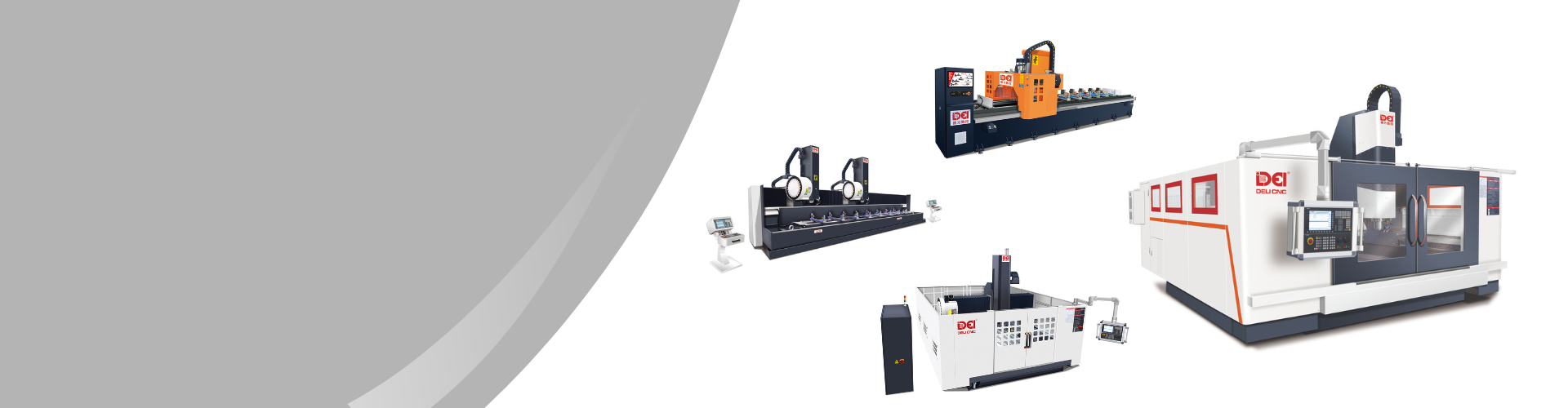
DELICNC designs and manufactures five equipment families, each aimed at a distinct class of workpiece:
— Compact, fast, and cost-effective for small-to-medium precision parts, molds, and aluminum housings. Rigid HT300 integrated cast beds and linear guideways keep them accurate through high-speed cycles.
— Double-column "bridge" structures for large, heavy, or long workpieces. FEA-optimized gantry frames and dual-side drive deliver the rigidity needed for EV trays, rail profiles, and aerospace structures.
5-axis profile machining centers — Purpose-built for long aluminum extrusions and complex multi-face profiles, with RTCP tool-following and A/C dual-drive swing heads that machine a part in one clamping.
— Integrated drilling, milling, and sawing for façade mullions, transoms, and window/door frames.
— Servo-controlled simultaneous dual-angle cutting for high-volume aluminum extrusion.
This is the single most common selection question we field, and the answer is structural, not budgetary.
Single-column vs double-column rigidity
A VMC carries the spindle on a single column (or C-frame). That is excellent for accessibility and a small footprint, but the cantilevered load introduces deflection under heavy or off-center cutting. A gantry machining center (sometimes called a CNC gantry milling machine) supports the spindle on a crossbeam between two columns. The double-column design closes the load path, raising gantry structure rigidity dramatically and damping vibration — the reason mold makers and aerospace shops favor it for long, uninterrupted finishing passes.
Rule of thumb: if your part fits on a table up to roughly 1,500 × 800 mm and is aluminum or mild steel, a VMC is usually right. Once parts exceed that — long EV trays, rail extrusions, large plates — the gantry's stationary, heavy table and long-axis travel win.
When to choose which
| Factor | Choose VMC | Choose Gantry |
|---|---|---|
| Part size | Small–medium | Large / long / heavy |
| Rigidity need | Moderate | High (thin-wall, deep cut) |
| Floor space | Compact | Large + reinforced foundation |
| Best for | Precision parts, molds, aluminum housings | EV trays, rail, aerospace structures |
| Investment | Lower | Higher, strong ROI at scale |
A 5-axis gantry extends this to large complex geometries; a 5-axis VMC does the same for smaller complex parts. Pick by envelope first, axis count second.
3-Axis, 4-Axis, or 5-Axis: Matching Configuration to Your Parts
3-axis handles standard plates, pockets, and simple cavities. It is the default for prototyping and general parts.
4-axis adds a rotary axis for multi-face machining — reducing setups and improving consistency on parts like housings and fixtures. 4-axis simultaneous processing also helps with wrapped or indexed features.
5-axis machines complex surfaces and profiles in one setup via 5-axis simultaneous machining. For curved aluminum profiles, impeller-like brackets, and large tray geometries, this eliminates cumulative clamping error and slashes handling time.
| Configuration | Typical application | Setup reduction | Best workpiece |
|---|---|---|---|
| 3-axis | Plates, brackets, molds | Baseline | Simple geometries |
| 4-axis | Multi-face housings, fixtures | Moderate | Indexed features |
| 5-axis (VMC) | Small complex aerospace parts | High | Curved, precision parts |
| 5-axis (gantry/profile) | EV trays, long profiles | Very high | Large complex profiles |
When a part has compound angles or deep pockets on more than one face, 5-axis is not a luxury — it is the only way to hit tolerance economically. For a deeper breakdown of axis configurations, see our guide to .
Aluminum is forgiving on speed but unforgiving on stability. Three problems dominate.
Controlling deformation in thin and large profiles
Thin-walled extrusions and large EV trays deflect under clamping force and cutting load. The fix is a combination of double-column gantry structure for rigidity, low-deformation clamping (pneumatic positioning fixtures with automatic avoidance), and machining strategies that distribute cutting force. A 5-axis gantry machining center for large EV battery trays lets you machine the part in a single setup, removing the re-clamping stresses that cause warpage.
Thermal deformation compensation
Spindles and frames heat during long runs; that growth moves the tool relative to the part. Thermal deformation compensation — often via in-machine sensors and a compensation model in the CNC controller — corrects this drift in real time. On gantry machines running hours-long aerospace cycles, it is the difference between holding ±0.02 mm and drifting past tolerance by lunch.
Profile machining centers for curtain wall, and automated sawing for volume
For façade work, a profile machining center processes curtain-wall mullion and transom sections with integrated drilling, milling, and corner joinery — far tighter than manual framing. For high-volume extrusion, an automated sawing line built around a double-head sawing machine delivers simultaneous dual-angle cuts with servo positioning, lifting throughput while keeping angle accuracy.
Practical example: In an EV battery tray program, switching from a 3-axis VMC (multiple setups) to a 5-axis gantry cut clamping operations from four to one, eliminated tray distortion, and reduced per-part cycle time by roughly a third — while improving first-pass yield.
Automotive & EV. Structural aluminum parts, chassis brackets, and especially demand large-format 5-axis gantry capability and deformation control. DELICNC supplies turnkey tray lines with process planning.
Aerospace. Long aluminum and titanium structural sections need gantry rigidity and 5-axis reach. DELICNC's 5-axis centers pass the "S-test" verification used to qualify machines for high-precision aerostructures.
Rail transit. Kilometer-scale aluminum profiles for car bodies and frames are machined on long-travel gantry and profile centers, where straightness over length is the hard requirement.
Window/door & curtain wall. Unitized curtain wall fabrication integrates cutting, milling, and drilling in one cell, shrinking lead time from raw extrusion to installed frame.
5G & PV (brief). Enclosures and PV bracket machining use the same aluminum-centric VMC and profile-center logic at higher volumes and tighter cost targets.
The machine is half the project. The other half is everything around it.
Standard vs custom sizing. Off-the-shelf travels cover most parts; custom beds pay off only for repeat large-format work (e.g., dedicated EV-tray lines). Right-size to today's part plus one growth step — over-specifying wastes capital.
Lead time & commissioning for large gantry machines. Gantry machines need reinforced foundations and longer build/commissioning cycles than VMCs. Plan the foundation and utilities before the machine ships; budget commissioning and operator training into the timeline.
Line integration. Consider material handling, chip evacuation, and downstream assembly. A profile cell that feeds directly into framing beats a standalone machine on total throughput.
Total cost of ownership. Look past sticker price. Energy, tooling, fixtures, downtime risk, and service response matter more than a 10% purchase discount. A reliable domestic CNC system (SIEMENS, MITSUBISHI, FANUC) with local support often beats a cheaper import on TCO.
Domestic vs imported control. Modern Chinese-machine builders pair imported controllers (FANUC/SIEMENS) with local service — you get proven control logic and fast support, closing the old "domestic vs imported" gap on cost-performance.
What is a CNC machining center?
A computer-controlled milling platform that drills, taps, bores, and contours a part in one setup under programmed tool paths, holding tight tolerances through automation.
Vertical vs gantry — which should I choose?
Match to part size and rigidity need. VMCs suit small–medium parts and molds; gantry machines suit large, long, or thin-walled parts needing high rigidity. Choose by envelope first.
How accurate is a CNC precision machining center?
Quality machines hold ±0.02 mm positioning accuracy; 5-axis models with closed-loop feedback and thermal compensation hold that over long runs.
What is a 5-axis profile machining center used for?
Long aluminum extrusions and complex multi-face profiles — curtain-wall sections, EV trays, rail profiles — machined in one clamping via RTCP tool-following.
How do I choose a CNC machining center for aluminum?
Prioritize high-speed electrospindle, rigid guideways, and correctly sized travel. For long/thin sections, choose a gantry or profile center with deformation-control clamping.
How do I reduce machining deformation in aluminum profiles?
Use rigid double-column structures, low-deformation pneumatic fixtures, single-setup 5-axis machining, and cutting strategies that balance load — plus thermal compensation for long cycles.
Domestic CNC system vs FANUC/SIEMENS — which is better?
Pair an imported controller (FANUC/SIEMENS/MITSUBISHI) with local service. You get proven control logic and faster support — strong cost-performance without the old reliability gap.
What is the typical lead time for a large gantry machining center?
Longer than a VMC — foundations, build, and commissioning add weeks to months. Plan utilities and training early; your supplier should give a dated commissioning schedule.
Get a Free Technical Consultation
Choosing the right CNC precision machining solution starts with the part, not the brochure. Share your workpiece details — material, dimensions, tolerance requirements, batch size, and target industry — and DELICNC's application engineering team will return a free technical consultation, an equipment-selection evaluation, and a customized machining-solution proposal matched to your production reality.