
How to Choose a Vmc for Aluminum Parts
Aluminum usually machines well at higher cutting speeds, but spindle speed alone does not guarantee a good result.
A suitable VMC for aluminum should match the part size, alloy, tolerance, batch volume, tooling, and chip-control needs.
Chip evacuation matters because aluminum can produce a high volume of chips, and chip recutting can damage the surface finish.
Flood coolant, through-spindle coolant, mist or air blast each has a place. The right choice depends on the operation.
3-axis, 4-axis, and 5-axis machines can all be useful for aluminum. The best option depends on part geometry and setup strategy.
Introduction
Aluminum is common in aerospace, automotive, electronics, rail transit, construction, and general industrial parts because many aluminum alloys offer a useful mix of low weight, corrosion resistance, and machinability.
A vertical machining center (VMC) is often a practical choice for milling aluminum plates, housings, brackets, molds, fixtures, profiles, and similar components. The machine still has to be chosen carefully. A VMC that works well for steel roughing may not be the best fit for high-speed aluminum work, and a small general-purpose VMC may struggle with long profiles or large plates.
This guide explains what to check before choosing a VMC for aluminum parts, including spindle speed, torque, feed performance, rigidity, coolant, chip removal, axis configuration, automation, and when a horizontal or gantry machine may be a better fit.
Why aluminum needs the right VMC configuration
Aluminum is easier to cut than many steels, but that does not mean every VMC will produce accurate aluminum parts efficiently. The main issues are heat, chip control, tool loading, workholding, and the behavior of the specific alloy.
Softer aluminum alloys can feel gummy and may stick to the cutting edge if the tool, coating, coolant, or chip load is wrong. Harder alloys can take more force and may need a more rigid setup. Thin walls, long profiles, and large plates can also vibrate or distort if they are not supported properly.
For aluminum machining, the machine and process need to work together:
enough spindle speed for the cutter diameter and target cutting speed
enough power and torque for the depth of cut and tool size
fast, controlled feed and acceleration for modern toolpaths
rigid structure and stable workholding
reliable chip evacuation
coolant, air, or lubrication strategy suited to the operation
a controller that can process smooth, high-feed toolpaths
High-speed cutting, chips, and surface finish
Aluminum often benefits from higher cutting speeds than steel. That is why many shops look for VMCs with 12,000 rpm, 15,000 rpm, 20,000 rpm, or higher spindle options for aluminum work. An 8,000 rpm spindle can still be useful, especially with larger cutters, but it should be treated as a common baseline rather than a universal high-speed solution.
The correct spindle speed depends on cutter diameter, tool material, flute count, alloy, coating, chip load, and cutting strategy. A small end mill may need much higher rpm to reach the desired surface speed. A larger face mill may not.
Surface finish is not controlled by spindle speed alone. It also depends on tool runout, tool sharpness, feed per tooth, machine rigidity, workholding, coolant or air delivery, and whether chips are being cleared from the cut. Aluminum chips that stay in the cutting zone can be recut and dragged across the part, leaving scratches or built-up edge marks.
Common aluminum parts made on VMCs
VMCs are widely used for aluminum parts with flat faces, pockets, holes, slots, tapped features, and 2.5D or 3D contours. Typical examples include:
brackets, plates, covers, and mounting blocks
electronics housings, heat sinks, and front panels
automotive and EV-related plates, housings, and tray components
fixtures, molds, and prototype parts
machined features on aluminum extrusions
aerospace brackets, ribs, panels, and structural fittings where the machine, process, and quality system meet the required standard
Not every aluminum part is best made on a VMC. Long extrusions, very large plates, deep multi-sided work, or high-volume production may point toward a long-bed VMC, gantry machine, horizontal machining center, or dedicated profile machining system.
Key VMC specifications for aluminum machining
A good VMC choice starts with the part, not with a catalog page. Define the largest workpiece, the smallest tool, the tightest tolerance, the alloy, the number of operations, and the expected production volume. Then compare machines against those needs.
Spindle speed, torque, and power
The spindle is one of the first items to check. Aluminum cutting often favors a high-speed spindle, but the ideal spindle is not always the one with the highest rpm number.
Look at three things together:
Maximum rpm: important for small tools and high surface-speed finishing.
Torque curve: important for larger tools, roughing, and lower-speed cuts.
Power rating: important for maintaining the commanded speed under load.
For many aluminum jobs, a high-speed spindle with moderate torque is a good fit. For large face mills, heavy roughing, or thick billets, torque and power become more important. If the work also includes steel or cast iron, avoid choosing a spindle that is too narrowly optimized for aluminum.
Feed rate, acceleration, and rigidity
High spindle speed only helps if the machine can feed accurately enough to maintain the correct chip load. Aluminum machining often uses fast feeds, adaptive clearing, trochoidal paths, and light finishing passes. The machine therefore needs good acceleration, deceleration, servo response, and contouring performance.
Rigidity still matters. A light, flexible machine may chatter, especially with long tools, deep pockets, thin walls, or aggressive material removal. A stable casting, well-supported axes, quality guideways, and a properly designed spindle system help the machine hold tolerance and maintain a clean finish.
For aluminum, do not choose speed at the expense of control. A fast machine that vibrates or cannot follow the programmed path smoothly will not produce better parts.
Table size, work envelope, and axis travel
Check the work envelope against the real setup, not just the finished part size. Fixtures, vises, clamps, tool length, probing clearance, and chip-management space all reduce usable capacity.
For long aluminum profiles, X-axis travel may be the limiting factor. For deep cavities or tall fixtures, Z-axis travel and spindle nose clearance become important. For wide plates, table load and Y-axis travel may matter more than spindle speed.
Before choosing a VMC, confirm:
maximum workpiece size with fixture installed
table load capacity
X/Y/Z travel and clearance
distance from spindle nose to table
tool length and tool-change clearance
chip conveyor and coolant access around the fixture
Fixture space for small parts and long profiles
Small aluminum parts can often be run in multiple vises, modular fixtures, or custom fixture plates. This improves spindle utilization because several parts can be machined in one setup.
Long aluminum profiles need a different approach. They may require multiple supports, custom clamping, anti-vibration measures, and enough travel to machine features along the full length. If the profile is thin-walled, clamping pressure must be controlled to avoid distortion.
Ask these questions early:
Will the machine run one large part or many small parts per cycle?
Can the fixture support the part close to the cutting area?
Is there enough clearance for loading and unloading?
Will chips collect in the fixture or profile channels?
Can the operator access the clamps safely and repeatably?
Coolant, chip removal, and tooling systems
Aluminum chip control is one of the main reasons to choose one VMC configuration over another. Chips can build up quickly, especially during pocketing, drilling, and high material-removal operations. The machine should clear chips without constant manual cleaning.
Flood coolant, through-spindle coolant, mist, and air blast
Flood coolant is common and useful for cooling, lubrication, and chip washing. It works well for many general milling and drilling operations, provided the nozzles are aimed correctly and the flow reaches the cutting zone.
Through-spindle coolant can be helpful in deep drilling, pocketing, and operations where chips must be pushed out from inside the cut. It is not automatically better for every aluminum milling job, but it can reduce chip packing and tool breakage in the right application.
Air blast is often used in aluminum finishing or high-speed milling where chip clearing is more important than heavy cooling. It keeps chips away from the tool and part surface, but it does not remove heat as effectively as flood coolant. Some shops also use minimum quantity lubrication (MQL) for selected aluminum operations, depending on tooling, cleanliness requirements, and machine setup.
The practical rule is simple: choose the coolant or air strategy that keeps the cutting edge lubricated, controls heat, and clears chips from the cut.
Chip conveyor and enclosure design
Aluminum can produce a large volume of light chips. Depending on the alloy, tool, and cutting strategy, chips may be small, curled, stringy, or packed into cavities. A chip conveyor reduces downtime and helps keep the machine stable during longer runs.
The enclosure matters too. Steep internal surfaces, fewer chip traps, good washdown, and accessible cleanout points make a real difference. A machine may have a conveyor but still require frequent cleaning if chips collect on shelves, around fixtures, or behind guards.
When comparing VMCs, check:
conveyor type and chip capacity
washdown coverage
enclosure slope and chip traps
coolant filtration for fine aluminum particles
access for manual cleanout and maintenance
seal protection around the guideways and ballscrews
Automatic tool changer and tooling setup
Most modern VMCs have an automatic tool changer (ATC), but capacity and reliability still matter. Aluminum parts may require roughing tools, finishing tools, drills, taps, chamfer tools, thread mills, probes, and spare sister tools. If the ATC is too small, operators will spend more time changing tools between jobs.
Tool-change time also affects production, especially for parts with many short operations. For high-volume work, compare tool-to-tool and chip-to-chip times, but do not focus only on speed. A reliable ATC is more valuable than a fast one that causes stoppages.
Offline tool presetting can also help. Measuring tool length and diameter before loading tools into the machine reduces setup time and improves first-part accuracy.
Accuracy, control, and automation
Aluminum parts can be simple, but many applications still need tight tolerances, fine surface finish, and consistent repeatability. Mechanical accuracy, controller performance, probing, tool measurement, and thermal behavior all affect the final part.
CNC controller and high-speed machining functions
High-speed aluminum machining requires smooth motion. The controller must process dense toolpaths, look ahead through upcoming moves, and adjust acceleration so the machine does not jerk through corners or leave marks on the surface.
Useful controller features include:
look-ahead control
smoothing or high-speed machining modes
accurate contour control
toolpath tolerance settings
good feed control in small moves
support for probing and tool measurement cycles
Modern CAM strategies such as adaptive clearing, trochoidal milling, and peel milling can help maintain more consistent tool engagement. These strategies reduce sudden load changes and can improve tool life, but they still depend on a capable controller and a rigid machine.
Probing, tool measurement, and compensation
On-machine probing can reduce setup time and help avoid manual offset errors. A workpiece probe can locate the part, set work offsets, check stock position, and inspect selected features during or after machining.
Tool measurement systems measure tool length and, depending on the system, diameter or breakage. This is useful when running tight-tolerance aluminum parts or jobs with many tools.
Some VMCs also offer error compensation for geometric and thermal behavior. These functions can improve consistency, but they do not replace a stable environment, proper warm-up, good maintenance, and a controlled machining process.
3-axis, 4-axis, and 5-axis choices
A 3-axis VMC is often enough for plates, brackets, pockets, covers, and parts with most features on one or two accessible faces. It is usually the simplest and most cost-effective option.
A 4-axis setup adds rotary positioning. It can reduce the number of setups for parts with features on multiple sides, improve repeatability, and make small-batch production more efficient.
A 5-axis machining center is useful for complex contours, angled features, aerospace-style structural parts, impellers, and parts where one setup can reduce accumulated error. It also allows shorter tools in some cases, which can improve rigidity and surface finish. The tradeoff is higher machine cost, more demanding programming, and more complex setup verification.
| Axis configuration | Suitable applications | Main benefit |
|---|---|---|
| 3-axis | Plates, brackets, pockets, 2.5D parts | Lower cost and simpler setup |
| 4-axis | Multi-side parts, indexed operations, small batches | Fewer setups and better repeatability |
| 5-axis | Complex contours, angled features, aerospace-style parts | Better access and possible single-setup machining |
Automation for batch production
Automation can help when the part, fixture, and process are stable. It is less useful if the job changes constantly or still needs manual adjustment after every cycle.
Common automation options include:
pallet changers for preparing one setup while another is being machined
robotic loading and unloading for repeatable blanks or fixtures
part probing for offset updates and in-process checks
tool-life management and sister tools for longer unattended runs
chip and coolant systems sized for extended operation
For aluminum batch production, automation should be planned together with chip management. A robot or pallet system will not help much if the machine has to stop because pockets fill with chips.
VMC vs. HMC for aluminum parts
A VMC has a vertical spindle. The tool approaches the workpiece from above. An HMC has a horizontal spindle. The tool approaches from the side.
Both can machine aluminum. The better choice depends on part shape, volume, fixture strategy, and chip-control needs.
Main differences
On a VMC, setup is usually easier to see and access. Operators can look down at the table, fixture, and part. This is useful for prototypes, small batches, repair work, flat plates, and jobs that change often.
The downside is chip accumulation. Chips can sit on the part, in pockets, on fixtures, and around vises. Coolant and air blast can manage this, but deep cavities may still need careful programming and washdown.
On an HMC, gravity usually helps chips fall away from the workpiece. HMCs also often use tombstone fixtures and pallet changers, which can improve spindle uptime in production. The tradeoff is higher cost, more complex fixturing, and less direct visibility during setup.
When a VMC is a better fit
A VMC is often the practical choice for:
flat or plate-like aluminum parts
housings, covers, brackets, and panels
prototypes and small to medium batches
job shops that need flexibility
large plates that are easier to load onto a horizontal table
parts that do not justify the cost or fixture complexity of an HMC
For many aluminum projects, a well-configured VMC with the right spindle, coolant, tooling, and chip conveyor is the most economical solution.
When an HMC or gantry machining center may be better
An HMC may be better for high-volume production, multi-side parts, tombstone workholding, or operations where chip evacuation is a constant problem.
A gantry or bridge-type machining center may be better for very large aluminum plates, long structural components, molds, rail parts, or aircraft-style structural parts that exceed the travel, table load, or clearance of a standard VMC.
In these cases, the question is not whether aluminum can be machined on a VMC. It can. The question is whether the VMC is still the most stable, productive, and cost-effective platform for the specific part.
DELI CNC options for aluminum part manufacturing
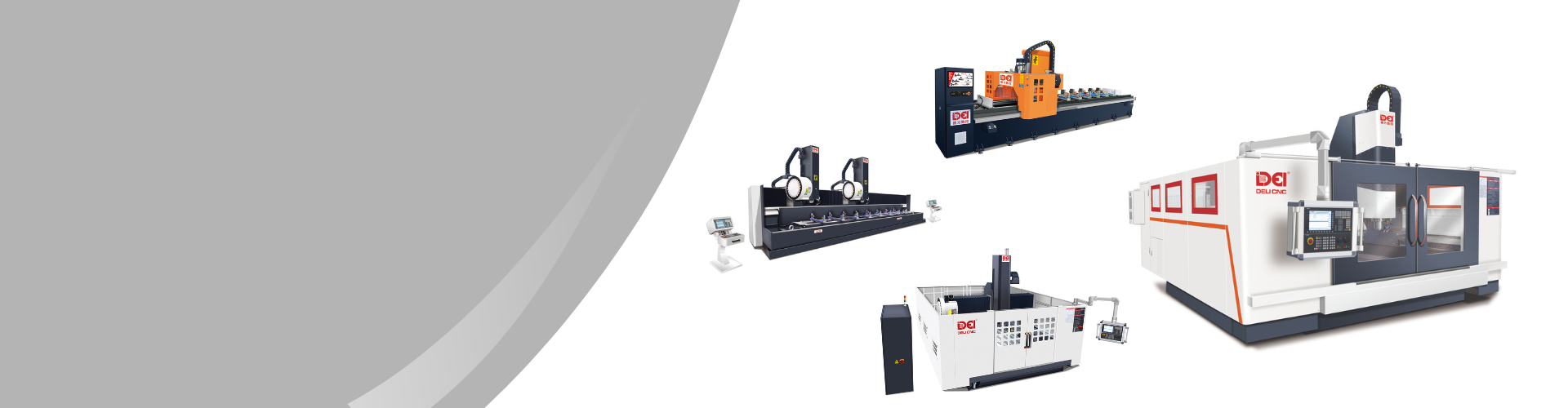
DELI CNC / DELICNC's official website lists CNC vertical machining centers, CNC gantry machining centers, double-column machining centers, and five-axis related gantry or bridge-type models. That gives buyers several machine categories to consider for aluminum work, from general VMC applications to larger structural components.
Because model specifications vary, the best choice should be based on the actual drawing, alloy, tolerance, tool list, and production plan.
Vertical machining centers for general aluminum parts
A vertical machining center is usually the starting point for aluminum brackets, housings, covers, plates, fixtures, and prototypes. For these parts, compare spindle speed, table size, axis travel, ATC capacity, coolant delivery, chip conveyor design, and controller functions.
For lighter aluminum work, a high-speed spindle and responsive motion may matter more than heavy low-speed torque. For larger billets, thicker plates, or mixed-material production, rigidity and spindle power become more important.
Heavy-duty and double-column machines for larger workpieces
DELI CNC's website includes vertical machining center models described for heavy-duty cutting or heavy-duty machining, as well as double-column machining center products. These machine types are worth considering when aluminum workpieces are large, when fixtures are heavy, or when the cutting process needs more structural support.
A double-column or bridge-style structure can help when machining wide plates, large molds, frames, or other parts where a standard C-frame VMC may not provide enough travel or support.
Gantry and five-axis solutions for complex or oversized parts
The official DELI CNC website also lists CNC gantry machining centers and five-axis related gantry or bridge-type machines. These are more suitable for oversized parts, long structural components, or complex surfaces that need better tool access.
A five-axis machine can reduce setups for complex aluminum parts, but it should not be chosen only because it is more advanced. It makes sense when it solves a real problem: difficult angles, complex contours, tight relationship tolerances between faces, or excessive error from repeated re-clamping.
Industries and aluminum products commonly made on VMCs
Aerospace brackets and structural components
Aerospace manufacturers use aluminum alloys for many lightweight structural parts. VMCs and five-axis machining centers can produce brackets, ribs, panels, fittings, and other components when the machine, process, inspection, and quality documentation meet the required standard.
For aerospace-style parts, the priorities are usually repeatability, traceability, tool control, surface integrity, and reliable measurement. A 5-axis machine may reduce setup error on complex parts, but a stable 3-axis or 4-axis process can still be suitable for simpler components.
Automotive and EV battery tray components
Automotive manufacturers use aluminum to reduce weight in selected components. VMCs can machine housings, brackets, plates, chassis-related parts, prototype components, and features on castings or extrusions.
EV battery trays and enclosures are often made from aluminum extrusions, castings, sheet structures, or welded assemblies. Machining may be needed for mounting holes, sealing surfaces, slots, pockets, and local features. Large-travel VMCs, gantry machines, or dedicated profile systems may be required depending on the tray size and production volume.
Electronics housings, fixtures, molds, and industrial parts
Aluminum is common in electronics because it is light, machinable, corrosion resistant, and good at conducting heat. VMCs are used for heat sinks, enclosures, front panels, mounting plates, and precision housings.
VMCs are also used to make production fixtures, inspection fixtures, molds, dies, and general industrial components. In these applications, the machine's accuracy affects not only the part being cut, but also the repeatability of later production steps.
Long aluminum profiles for construction and rail transit
Extruded aluminum profiles often need secondary machining after extrusion. VMCs or profile machining centers can add holes, slots, end cuts, drainage features, fastener locations, and assembly details.
Door and window frames, curtain wall components, industrial frames, and rail-transit profiles may require long X-axis travel and careful support. For thin-wall profiles, the fixture must prevent vibration without crushing or distorting the extrusion.
How to select the best VMC for your aluminum project
Start with the part and process
Before asking for a machine quote, prepare the basic information:
part drawing or 3D model
overall dimensions and weight
aluminum alloy and stock form
tolerance and surface-finish requirements
annual volume and batch size
roughing and finishing operations
smallest and largest tools
expected fixture concept
inspection requirements
This prevents two common mistakes: buying a machine that is too small for the real setup, or paying for features that do not improve the job.
Compare the machine specifications that affect the cut
For aluminum work, compare:
spindle rpm, torque, and power
maximum feed rate and acceleration
controller look-ahead and high-speed machining functions
X/Y/Z travel and table load
spindle-to-table clearance
ATC capacity and tool-change time
flood coolant, through-spindle coolant, air blast, or MQL options
chip conveyor and enclosure design
probing and tool measurement options
automation readiness if batch production is planned
Do not judge the machine by one number. A 20,000 rpm spindle is not enough if chip evacuation is poor. A large table is not enough if the machine lacks rigidity. A 5-axis machine is not automatically better if the part only needs simple 3-axis milling.
Requesting a recommendation from DELI CNC
If you are comparing VMC options for aluminum parts, send DELI CNC the actual application details rather than only asking for a machine model. Useful information includes part drawings, material grade, workpiece size, tolerance, surface finish, batch volume, fixture concept, and whether the job needs 3-axis, 4-axis, 5-axis, double-column, or gantry capacity.
With those details, the supplier can recommend a machine configuration that fits the part instead of guessing from a general description.
Conclusion
Choosing a VMC for aluminum parts is a balance between speed, rigidity, travel, chip control, coolant strategy, tooling capacity, and automation. Aluminum can be forgiving in some ways, but poor chip evacuation, weak workholding, or the wrong spindle choice can still lead to chatter, scratches, tool wear, and dimensional problems.
For small and medium aluminum parts, a well-equipped VMC is often the most practical choice. For multi-side production, an HMC may improve chip flow and spindle uptime. For oversized plates, long profiles, or complex structural parts, a gantry, bridge-type, double-column, or five-axis solution may be more appropriate.
The safest way to choose is to start with the part drawing and machining process, then match the machine to the real cutting conditions.
FAQs
What spindle speed is best for machining aluminum on a VMC?
There is no single best rpm. Aluminum often benefits from higher spindle speeds, and many aluminum-focused VMC applications use 12,000 rpm, 15,000 rpm, 20,000 rpm, or higher. An 8,000 rpm spindle can work for many jobs, especially with larger tools, but small cutters may need higher rpm to reach the right cutting speed.
Is a 3-axis, 4-axis, or 5-axis VMC better for aluminum parts?
It depends on the part. A 3-axis VMC is suitable for many plates, brackets, and housings. A 4-axis setup helps with indexed multi-side machining. A 5-axis machine is useful for complex contours, angled features, and parts where reducing setups improves accuracy.
Can a VMC used for aluminum also machine other metals?
Yes, many VMCs can machine other non-ferrous metals and steels if the spindle, tooling, coolant, and cutting parameters are appropriate. A machine optimized mainly for high-speed aluminum may not be as efficient for heavy steel cutting as a machine with more low-speed torque and rigidity.
What surface finish is achievable on aluminum parts made by VMCs?
With the right machine, tool, workholding, coolant, and cutting parameters, aluminum parts can achieve fine machined finishes. A finish around 32 µin Ra, or about 0.8 µm Ra, is achievable in many CNC milling applications, but it is not guaranteed for every part or setup.
How does VMC machining help aerospace aluminum component production?
VMC and five-axis machining can produce lightweight aluminum brackets, ribs, panels, and structural fittings with repeatable geometry. For aerospace work, the machine must be supported by the right process control, inspection, documentation, and quality system.