
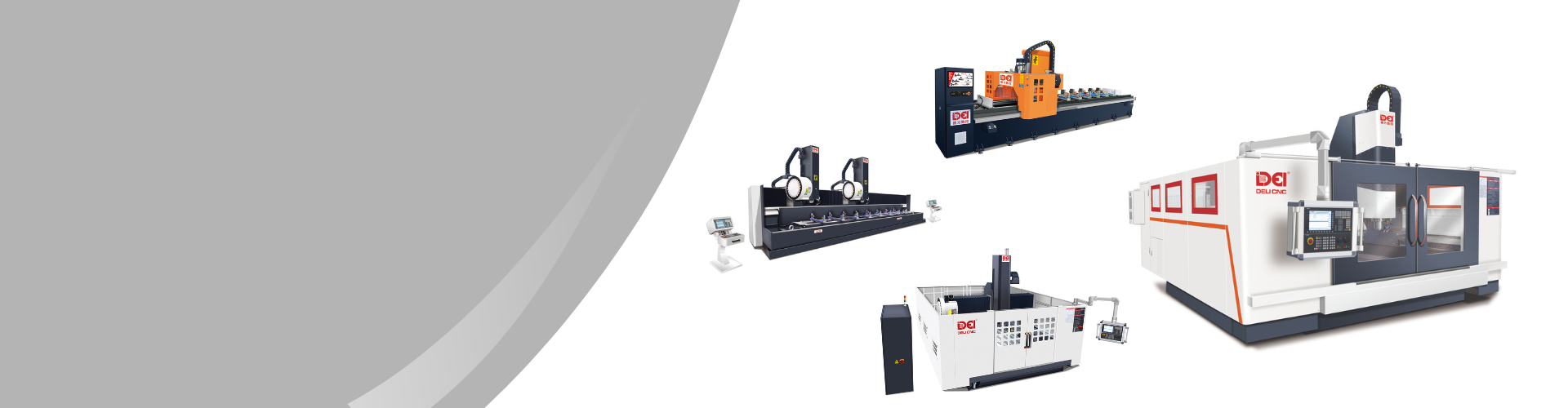
How 5-Axis CNC Gantry Machining Centers Eliminate Machining Deformation in Large Aluminum EV Battery Trays
For manufacturers producing these large-scale components, the hidden quality killer is dimensional deformation. When machining extruded aluminum battery trays that frequently exceed 2,000 mm in length, even a small amount of twisting or warping can cause seal failures, module assembly interference, or structural compromises.
Solving these machining problems means bringing machine tool rigidity, 5-axis kinematics, and application process engineering together. DELICNC, a global engineering partner specializing in large-format aluminum profile processing and high-precision CNC machine tools, has developed an end-to-end engineering framework that suppresses stress at the source and dynamically compensates for deformation throughout the cutting cycle.
This article is a technical look at the physical root causes behind aluminum machining deformation, and how high-precision 5-axis CNC gantry machining centers, paired with optimized fixturing and toolpaths, push distortion down to achieve repeatable, high-yield mass production.

Deep Dive: The Root Causes of Aluminum Deformation in EV Applications
To eliminate machining deformation, process engineers first need to understand what aluminum actually does during heavy material removal. Aluminum alloys (such as the 6000 series) are the material of choice for EV battery trays because of their strength-to-weight ratio and thermal conductivity. Those same physical properties also cause trouble under high-speed cutting forces.
1. The Insidious Impact of Residual Stress
Residual stress is the internal tension locked inside aluminum billets or extruded profiles during initial casting, hot rolling, or heat treatment (such as T6 solution heat treatment and artificial aging). When a CNC machine performs deep cavity milling or aggressive material removal, this internal force balance gets disrupted. As the locked-in forces release unevenly, the aluminum workpiece physically shifts, warps, or twists.
In large aluminum battery tray production, residual stress is the main cause of post-machining warpage. Even with stress-relieved plate stock (such as 6061-T651), removing 60% to 80% of the raw material to form thin walls and intricate cooling channels unleashes enough internal tension to push the part well outside strict geometric tolerances.
If the machine tool lacks the dynamic rigidity to maintain precise tool-to-part contact, or if the machining strategy releases stress too aggressively in a single pass, the workpiece springs back the moment it is released from the fixtures.
2. Physical Mechanics of Large-Format, Lightweight Aluminum Machining
Beyond metallurgical stress, the physical geometry of an EV battery tray introduces its own dynamic cutting forces:
Ultra-Thin Walls and Tool Deflection: To hit lightweight targets, battery tray wall thicknesses are commonly engineered down to 1.5 mm to 3.0 mm. Under high cutting forces, these thin walls suffer from chatter and deflection, which pushes the wall away from the cutting edge and causes uneven wall thickness and poor surface finishes.
Cumulative Thermal Expansion: Aluminum has a high coefficient of thermal expansion ($\approx 23 \times 10^{-6} / \text{K}$). On a large 2-meter workpiece, a minor temperature rise of just $2^\circ\text{C}$ causes an axial expansion of over $0.09 \text{ mm}$, a deviation that ruins tight hole-location tolerances.

The Engineering Solution: 5-Axis Single Setup Machining
Overcoming deformation takes an integrated solution that combines advanced machine kinematics with low-stress clamping. Moving from traditional multi-setup 3-axis or 4-axis operations to true 5-Axis Single Setup Machining is the most effective mechanical path to eliminating cumulative tolerance stack-up on large aluminum structural parts.
Eliminating Tolerance Stack-Up via Simultaneous 5-Axis Kinematics
In traditional 3-axis setups, machining the tray's bottom sealing face, side mounting holes, and internal coolant channels requires 4 to 6 separate clamping cycles and manual flips. Every time a workpiece is unclamped, flipped, and re-aligned, human error and fixture locating variations introduce tolerance stack-up.
A 5-axis CNC gantry machining center removes this variable. Using 5-axis simultaneous motion, the high-performance swivel head (A/C or B/C axis) approaches the workpiece from virtually any spatial angle while the part stays locked down in its original orientation on the machine table.
Engineering Insight: The critical spatial relationships between top sealing faces and bottom mounting pads are governed entirely by the machine tool's intrinsic spatial geometric accuracy, with operator alignment variability taken out of the equation.
The Decisive Role of Low-Stress Fixturing Design
Even advanced 5-axis kinematics will fail if the clamping strategy introduces artificial pre-loads into the raw part. The goal of optimized fixturing is to hold the part securely without forcing it into a stressed shape.
Excessive localized clamping forces flatten warped raw stock against the fixture by force. The machine cuts the part perfectly flat in this constrained state, but the moment the clamps are released, the aluminum springs back to its natural resting state and ruins all flatness tolerances.
To counteract this, modern application engineering recommends a hybrid clamping approach:
Low-Profile Hydraulic Clamping: Low-profile hydraulic clamps exerting constant, calibrated pressure, paired with self-adjusting floating supports underneath thin, unsupported spans to prevent deflection without over-constraining the part.
Multi-Zone Vacuum Workholding: For thin-bottomed trays, dividing the table into independently controlled vacuum zones distributes holding force uniformly across the entire footprint, eliminating stress concentration points.
Conformal Sacrificial Soft Jaws: Custom soft jaws machined to mirror the exact profile of the battery tray, maximizing surface contact area and drastically reducing the required clamping pressure.
Core Machine Architecture for Precision Gantry Performance
Running a single-setup strategy over long cutting cycles requires a machine tool built for rigidity and thermal stability. Taking the engineering practices in the DELICNC 5-Axis Gantry Machining Centers (such as the MDF 5-Axis Series) as a benchmark, stability comes from three structural pillars:
1. Thermally Symmetric Bridge Design & Vibration Damping
Machining a complete EV battery tray often involves cycle times from 2 to 6 hours. Holding absolute geometric stability over these long runs takes a solid machine structure.
FEA-Optimized Structural Castings: A heavy-duty, thermally symmetric bridge design optimized via Finite Element Analysis (FEA). Rib layout and wall thicknesses are engineered to deliver high natural frequencies and strong vibration damping, absorbing high-speed aluminum roughing forces without structural deflection.
Direct Full-Closed Loop Feedback: Linear axes (X/Y/Z) are equipped with high-precision absolute linear glass scales. By reading physical axis positions directly, the system eliminates thermal growth errors and mechanical backlash inherent in ball screws.
2. Multi-Layer CNC Thermal Management
Thermal buildup is the invisible enemy of long-cycle precision. High-speed spindle rotation, ball screw friction, and ambient shop floor temperatures all cause micro-expansions in the machine's structure.
To hold micron-level repeatability, DELICNC integrates three layers of active thermal control:
Internal Core Cooling: Constant-temperature cooling oil circulates through the spindle core and hollow ball screws, actively pulling heat away from high-speed friction points before it transfers to structural castings.
Real-Time CNC Thermal Displacement Compensation: Multi-point RTD temperature sensors are embedded into key structural nodes (gantry crossbeams, columns, and spindle heads). The CNC controller processes real-time thermal data through pre-calibrated mathematical models, dynamically adjusting axis offsets to compensate for structural expansion.
Dynamic CAM Toolpath Optimization: On the programming level, trochoidal milling and adaptive clearing toolpaths maintain a constant cutter engagement angle. This prevents sudden spikes in cutting forces and friction heat, minimizing thermal transfer into the aluminum workpiece.
3-Axis vs. 5-Axis Gantry Solutions: ROI Analysis for EV Manufacturers
For plant managers and procurement directors, investing in a high-precision 5-axis gantry center is a significant Capital Expenditure (CapEx). Whether it pays off depends not on the initial price tag but on Total Cost of Ownership (TCO) and piece-part margins.
Operational Comparison Matrix
| Operational Metric | Traditional Multi-Setup 3-Axis Approach | Integrated High-Rigidity 5-Axis Gantry Solution(e.g., DELICNC MDF 5-Axis Platform) | Impact on Production & Bottom Line |
|---|---|---|---|
| Required Setups | 4 to 6 Setups (Frequent manual flipping & re-alignment) | 1 Single Setup (Complete multi-sided machining in one hold) | Reduces non-cutting auxiliary time by over 70%; eliminates operator intervention. |
| Fixturing Complexity | Multiple expensive dedicated flip-fixtures and CMM gauges | Single primary datum fixture / modular vacuum table | Cuts upfront tooling CapEx and reduces physical fixture storage overhead. |
| Tolerance Stack-Up Risk | High (Cumulative alignment errors from multiple datum shifts) | Near Zero (All features machined relative to a single primary datum) | Eliminates costly downstream assembly interference with battery modules and chassis. |
| Scrap Rate | 3% – 8% (Driven by operator misalignments & stress spring-back) | < 1% (Controlled stress release and thermal compensation) | Directly boosts material yield on expensive extruded aluminum profiles. |
| Spindle Utilization (OEE) | Lower (Spindle sits idle during manual part re-clamping) | Increased by 40% – 60% (Continuous 5-axis cutting execution) | Dramatically increases daily unit output (UPH) per machine cell. |
Quantifying the Return on Investment (ROI)
5-axis gantry centers require a higher initial capital outlay than basic 3-axis machines, but the Operational Expenditure (OpEx) savings are real:
Scrap Cost Reduction: On a production line running 50,000 battery trays annually, dropping the scrap rate from 5% to under 1% yields large annual savings in raw aluminum stock and upstream extrusion costs alone.
Floor Space and Labor Consolidation: A single high-efficiency 5-axis gantry center frequently replaces 2.5 to 3 conventional 3-axis machines, freeing up floor space and cutting direct labor requirements.
Factoring in scrap reduction, labor optimization, and the premium margins unlocked by securing Tier-1 EV automotive contracts, the payback period for a DELICNC 5-Axis Gantry Center typically lands between 18 to 24 months.
Frequently Asked Questions (FAQ)
Q: How can process engineers prevent deformation in large aluminum EV battery trays right from the start?
A: Preventing deformation takes a three-pronged approach: specify stress-relieved raw material (e.g., 6061-T651); deploy low-profile hydraulic and vacuum workholding to prevent artificial pre-loading; and adopt 5-axis single-setup machining to cut complex geometry without unclamping the part, so internal stresses relieve predictably.
Q: Which machine tool features are most critical when machining large-format EV battery trays?
A: The most critical hardware features: an FEA-optimized gantry structure with high vibration damping (to suppress chatter on thin walls); direct full-closed loop linear scales (for long-stroke positioning accuracy); and internal spindle/ball screw cooling paired with real-time CNC thermal displacement compensation (to control long-cycle thermal drift).
Turning "Deformation Control" into Predictable Mass-Production Yields
Eliminating machining distortion in large aluminum EV battery trays is not as simple as buying an expensive machine tool. It is an engineering discipline that combines residual stress management, low-stress workholding, dynamic toolpath planning, and machine thermal stability.
The engineering team at DELICNC provides more than standalone 5-axis gantry machining centers. We partner with Tier-1 automotive suppliers and OEMs to deliver end-to-end Application Engineering Support.